The Essential Link Between ERP PLM Integration
In a market where competitive advantage depends on faster product launches, businesses cannot afford delays in design, manufacturing, or delivery. Many production delays come from miscommunication between engineering, production, and quality teams, especially when siloed systems prevent a unified flow of product data. That’s where ERP PLM integration (Enterprise Resource Planning and Product Lifecycle Management) helps establish a digital thread in manufacturing.
When ERP and PLM systems work together, they connect design innovation with manufacturing, supply chain performance, real-time collaboration, and operational visibility. This connection does more than automate data transfer; it improves collaboration, reduces errors, and supports faster product development across the product lifecycle.
Now, let’s examine how ERP supports PLM and how this integration can transform your business.
Understanding ERP and PLM Systems in ERP PLM Integration
Let’s start by looking at how ERP and PLM operate independently before they are integrated.
PLM (Product Lifecycle Management) Overview
Product Lifecycle Management (PLM) forms the hub of product development. It manages and stores product information, from concept ideas and CAD drawings to change order requests and engineering change requests (ECRs). PLM owns the product identity: what the product is, how it is designed, and how it evolves over time. It brings design, engineering, and research teams together by keeping versions controlled, documents accurate, and product data consistent. From concept to retirement, PLM serves as the single source of truth for product data management (PDM), helping maintain design intent, traceability, and compliance throughout the product lifecycle.
ERP (Enterprise Resource Planning) Overview
Enterprise Resource Planning (ERP), on the other hand, manages how the product is actually made, costed, stocked, and delivered. It supports procurement, inventory management, production planning, finance, manufacturing execution, and delivery. By connecting these areas, ERP helps monitor costs, plan production around customer demand, coordinate purchasing, and maintain operational consistency across manufacturing and logistics. It also supports supply chain planning and gives teams better visibility into day-to-day operations.
Why ERP–PLM Integration Matters for Manufacturers
These systems need to communicate when a new product is ready for manufacturing. ERP–PLM integration synchronizes engineering BOM (eBOM) and manufacturing BOM (mBOM) data so teams can maintain a single product definition across departments. This helps move engineering specifications into production without manual re-entry, reducing errors, delays, and data inconsistencies. With bi-directional ERP–PLM integration, engineering and operations teams can work from synchronized product data and support lean, connected manufacturing.
How ERP–PLM Integration Improves Product Development
Once ERP and PLM are integrated, product design and manufacturing become more connected. The systems work together to move an idea from concept to production with better coordination between engineering, procurement, production, and quality teams. This connection helps companies manage product data, track changes in cost and schedule, and keep teams aligned as the product moves through each stage of development.
ERP supports Product Lifecycle Management by improving data integrity, reducing manual errors, and centralizing records for easier audits and issue tracking. With shared, up-to-date data, teams can make faster decisions from early design through production and post-launch support.
The Impact of ERP–PLM Integration Across the Product Lifecycle
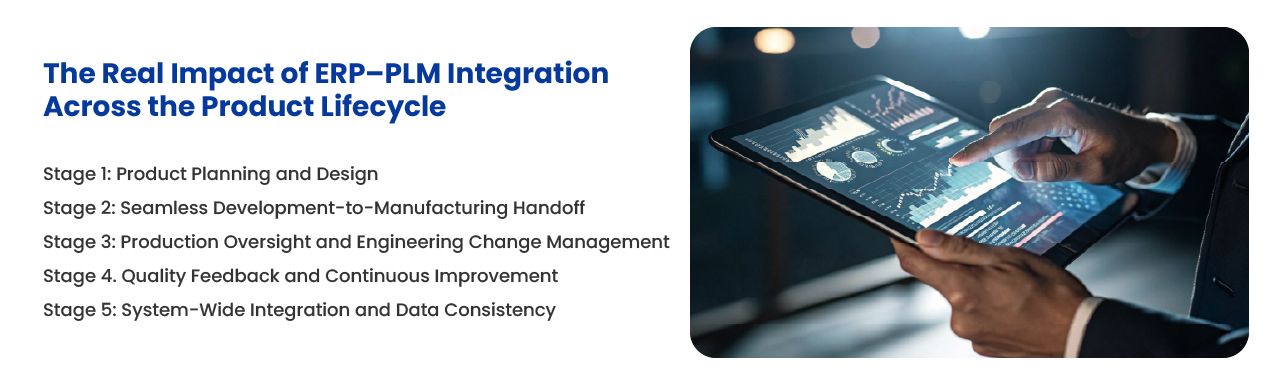
Product Planning and Design
ERP gives designers access to current costs, material availability, labor rates, reusable parts, and approved suppliers. This helps teams design products around financial, manufacturing, and operational constraints from the start.
Development-to-Manufacturing Handoff
ERP–PLM integration helps synchronize PLM’s engineering BOM (eBOM) with ERP’s manufacturing BOM (mBOM) through master data management (MDM). It also connects routing, work centers, and packaging guidelines so the production team receives a clear manufacturing execution plan.Production Oversight and Engineering Change Management
When ERP and PLM systems are connected, design changes can trigger updates in purchase orders and production orders, improving engineering change management and supporting lean, connected manufacturing. This helps the shop floor work from the latest specifications, reducing errors and rework across departments.
Quality Feedback and Continuous Improvement
ERP records defects, warranty claims, and product performance data from the field, then feeds this information back into PLM through product quality analytics and data-driven quality management. This closed-loop process helps engineers understand real-world issues and improve future product designs.
System-Wide Integration and Data Consistency
ERP–PLM integration can also connect CRM (Customer Relationship Management), SCM (Supply Chain Management), and MES (Manufacturing Execution System) around master data, BOMs, and specifications. This gives enterprise teams a single source of truth across product development, manufacturing, supply chain, and customer-facing operations.
Talk to an ERP–PLM Expert
Step-by-Step ERP–PLM Integration Workflow
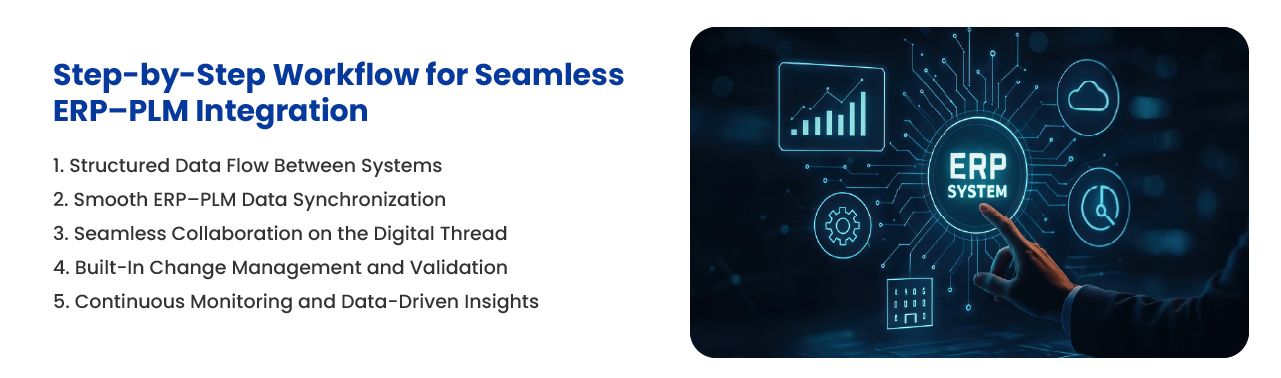
1. Structured Data Flow Between Systems
ERP–PLM integration begins with mapping each product attribute from the PLM system to the right field in the ERP system. This supports master data management (MDM) and helps keep product data accurate and synchronized across business functions.
2. Smooth ERP–PLM Data Synchronization
Once data is mapped, item masters, BOMs, and documents can be synchronized automatically. This means PLM updates can flow into ERP for purchasing, costing, production planning, and inventory management.
3. Seamless Collaboration on the Digital Thread
Integration creates a shared source of product information for real-time collaboration between design, manufacturing, procurement, and quality teams across the product lifecycle.
4. Built-In Change Management and Validation
With clear change request, approval, and validation workflows, PLM updates can flow into ERP without disrupting purchasing, production, or inventory operations.
5. Continuous Monitoring and Data-Driven Insights
After deployment, digital twins, IoT (Internet of Things), and analytics can help teams monitor product performance, support predictive maintenance, and improve product lifecycle optimization.
Common ERP–PLM Integration Challenges
ERP–PLM integration can become complex when product data, BOM structures, approval workflows, and system ownership are not clearly defined. Manufacturers often face issues such as duplicate item records, mismatched eBOM and mBOM data, delayed engineering change updates, and inconsistent master data across departments.
To avoid these problems, businesses should define data ownership, map product attributes carefully, validate change workflows, and choose an integration approach that supports real-time synchronization, API connectivity, and long-term scalability.
Building a Unified Digital Thread Across the Product Lifecycle
ERP–PLM integration provides a steady flow of information across every phase of a product’s life, from design to delivery and maintenance. By establishing a PLM ERP interface, businesses strengthen their digital foundation for connected, intelligent, and sustainable manufacturing.
At NOI Technologies LLC, we design cloud-based ERP–PLM integration solutions that support digital transformation, product innovation, cost control, and faster growth across manufacturing and supply chains.
Empower Your Business with Cloud ERP–PLM Integration