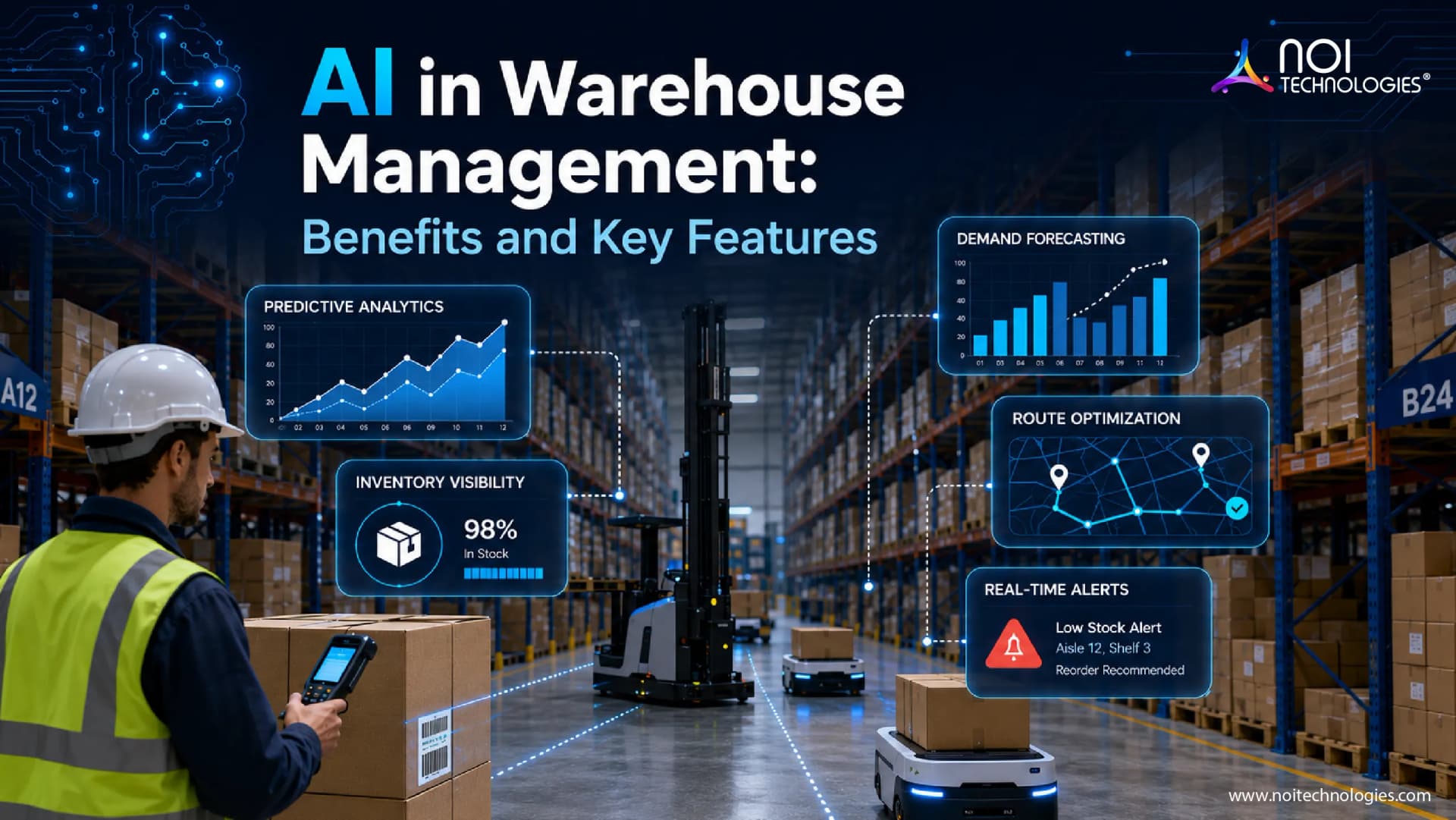
Warehouse operations are becoming more complex as ecommerce, retail, manufacturing, and distribution businesses handle higher order volumes, faster delivery expectations, and more inventory movement across multiple channels.
Artificial intelligence is now becoming an important part of warehouse management because it can help businesses improve forecasting, inventory visibility, order accuracy, picking efficiency, quality control, and operational decision-making.
AI in warehouse management does not replace the need for strong warehouse processes. Instead, it supports warehouse teams by using data, automation, and intelligent workflows to reduce manual work and improve daily operations.
This article explains the rise of AI in warehouse management, the challenges it helps solve, the main benefits, and the key AI features businesses should understand before investing in warehouse automation.
What Is AI in Warehouse Management?
AI in warehouse management refers to the use of artificial intelligence, machine learning, automation, and data analysis to improve warehouse operations. It can help warehouses forecast demand, track inventory, optimize picking routes, identify errors, automate documents, and provide faster operational insights.
In traditional warehouse operations, many tasks depend on manual updates, paper-based processes, spreadsheets, and human decision-making. AI-supported warehouse systems can reduce these manual steps by analyzing operational data and recommending or automating the next action.
For example, an AI-enabled warehouse management system may help identify fast-moving SKUs, predict stock requirements, flag inventory mismatches, support intelligent order picking, or provide real-time insights into warehouse performance.
According to Statista, the global warehouse automation market was valued at $23 billion in 2023 and was expected to reach $41 billion by 2027. Grand View Research also estimated that the U.S. warehouse management systems market was valued at $783 million in 2023 and projected to grow at a 20% CAGR through 2030.
These numbers show why businesses are paying closer attention to warehouse automation, AI-enabled WMS platforms, and better fulfillment technology.
Common Challenges in Traditional Warehouse Management
Many warehouses still rely on manual processes that become difficult to manage as order volume, SKU count, customer expectations, and fulfillment complexity increase.
Common challenges include:
- Labor-heavy workflows: Manual picking, packing, stock counting, and data entry can increase labor costs and slow down fulfillment.
- Inventory inaccuracies: Overstocking, understocking, misplaced items, and delayed stock updates can affect order fulfillment and customer satisfaction.
- Limited traceability: Without real-time tracking, teams may struggle to locate orders, products, equipment, or inventory movement.
- Higher fulfillment errors: Manual processes can lead to wrong-item shipments, missed orders, delayed dispatch, and returns.
- Poor demand visibility: Without accurate forecasting, businesses may struggle to plan inventory, labor, and warehouse capacity.
AI in warehouse management helps address these challenges by improving visibility, automating repetitive work, and helping teams make better decisions from warehouse data.
Benefits of AI in Warehouse Management
AI can support several parts of warehouse management, from demand planning to order fulfillment. The value depends on how well the system is connected with inventory data, order data, warehouse workflows, and business goals.
1. Better Demand Forecasting
AI can help warehouses forecast demand by analyzing sales history, seasonal trends, order patterns, product movement, and other business data.
Better forecasting helps businesses plan stock levels, labor requirements, storage space, and replenishment schedules more accurately. This can reduce the risk of overstocking slow-moving products or running out of high-demand items.
For ecommerce, retail, manufacturing, and distribution businesses, AI-based demand forecasting can make inventory planning more reliable and less reactive.
2. Improved Warehouse Productivity
AI can improve warehouse productivity by reducing repetitive manual work and helping teams focus on higher-value tasks.
For example, AI-supported systems can help prioritize orders, recommend picking routes, identify workflow delays, automate routine updates, and give managers better visibility into team performance.
This can reduce the time employees spend searching for items, checking stock manually, or switching between disconnected systems.
3. Better Quality Control
Quality control is important in warehouses that handle high-value goods, fragile items, regulated products, returns, batch tracking, or expiry-based inventory.
AI can support quality control by helping identify product damage, mismatched items, unusual return patterns, incorrect quantities, or inventory inconsistencies. In some warehouses, AI can also work with cameras, scanners, or sensors to support inspection workflows.
This improves the chance of detecting problems before products are shipped to customers.
4. Faster and More Accurate Order Fulfillment
AI can help make order fulfillment faster and more accurate by improving how orders are prioritized, picked, packed, verified, and shipped.
When AI is combined with warehouse management software, barcode scanning, and automation rules, teams can reduce manual errors and improve order flow.
This can help warehouses reduce picking time, avoid wrong shipments, and improve delivery reliability.
5. Real-Time Inventory and Order Tracking
Real-time tracking helps warehouse teams understand where inventory, orders, equipment, and shipments are at any stage of the process.
AI can make tracking more useful by identifying patterns, delays, mismatches, or unusual activity. For example, if a product is often picked from the wrong location or a specific order type repeatedly causes delays, AI can help surface that issue for review.
This level of visibility supports faster problem-solving and better operational control.
6. Lower Operational Costs
AI can help reduce warehouse costs by improving labor planning, inventory accuracy, order processing, storage usage, and error prevention.
Cost savings are not automatic. They depend on proper implementation, clean data, trained users, and workflows that match real warehouse operations. However, when AI is applied correctly, it can reduce avoidable costs linked to manual errors, reshipping, excess labor, stockouts, overstocking, and slow fulfillment.
Businesses can also use warehouse automation to improve backorder handling, fulfillment planning, and warehouse efficiency.
Key AI Features in Warehouse Management Systems
AI-enabled warehouse management systems can include different features depending on the size of the warehouse, order volume, industry, and operational requirements.
Some useful AI warehouse management features include:
Intelligent Order Picking
AI can help optimize picking by recommending better pick paths, grouping similar orders, identifying high-priority orders, and reducing unnecessary movement inside the warehouse.
Smart Query Management
AI-powered search and query tools can help warehouse teams quickly find information about products, orders, stock levels, returns, locations, and shipment status.
Automated Document Processing
AI can help process invoices, packing slips, shipping documents, purchase orders, receiving documents, and other warehouse-related paperwork. This reduces manual data entry and improves document accuracy.
AI Chatbots for Warehouse Support
AI chatbots can help users ask questions about inventory, orders, returns, shipments, or warehouse tasks. Instead of searching through multiple screens, users can get faster answers from connected warehouse data.
Fraud and Anomaly Detection
AI can help detect unusual patterns in orders, returns, stock adjustments, inventory movement, or user activity. This can support better control and reduce operational risk.
How AI Fits Into Warehouse Management Software
AI works best when it is connected to a strong warehouse management system. The WMS provides the operational foundation, while AI helps improve forecasting, task planning, reporting, exception handling, and decision support.
For example, an AI-enabled WMS can support:
- Inventory forecasting and replenishment planning
- Picking route optimization
- Order priority recommendations
- Real-time warehouse performance insights
- Automated alerts for inventory or fulfillment issues
- Returns analysis and quality control checks
For businesses that need warehouse management software, Fulfillor’s warehouse management system supports warehouse operations such as inventory management, order fulfillment, picking, packing, shipping, returns, and operational visibility.
Conclusion
The rise of AI in warehouse management reflects a larger shift toward smarter, more connected warehouse operations. Businesses need faster fulfillment, better inventory accuracy, lower error rates, and clearer operational visibility.
AI can support these goals by improving demand forecasting, productivity, quality control, order accuracy, tracking, and cost control. However, AI works best when it is built into practical warehouse workflows instead of being treated as a standalone feature.
For companies in ecommerce, retail, manufacturing, logistics, and distribution, AI-enabled warehouse management can help create a more efficient and scalable fulfillment operation.
Need Help With AI-Enabled Warehouse Management?
NOI Technologies helps businesses plan and build warehouse technology solutions that support automation, visibility, and operational efficiency.