
The future of ERP is becoming more modular. Businesses no longer want large, rigid systems that force every department into the same structure. They need ERP platforms that can adapt to changing workflows, new integrations, growing teams, and evolving customer demands.
Modular ERP systems give businesses the flexibility to choose, implement, and scale the specific ERP modules they need, such as finance, inventory, procurement, HR, CRM, warehouse management, analytics, and reporting. Instead of replacing the entire ERP system when requirements change, companies can add, update, or improve individual modules over time.
This makes modular ERP a practical approach for companies that want more flexibility, faster implementation, easier upgrades, and better long-term control than traditional monolithic ERP systems.
This article explains what modular ERP means, why it matters, and how it is shaping the future of enterprise software.
What Are Modular ERP Systems?
A modular ERP system is an enterprise resource planning platform built with separate but connected modules. Each module handles a specific business function, such as accounting, inventory, sales, purchasing, HR, manufacturing, warehouse management, customer management, or analytics.
Instead of deploying one large all-in-one ERP system with features the business may not need, companies can start with the modules that solve their immediate problems. As the business grows, they can add more modules or integrations without replacing the entire system.
For example, a growing company may begin with finance, sales, and inventory modules. Later, it may add warehouse management, business intelligence, ecommerce integration, multi-currency support, or AI-powered reporting.
This flexible ERP architecture allows businesses to build their ERP system around real operational needs instead of adjusting every process to fit a rigid software structure.
Why Modular ERP Systems Are the Future
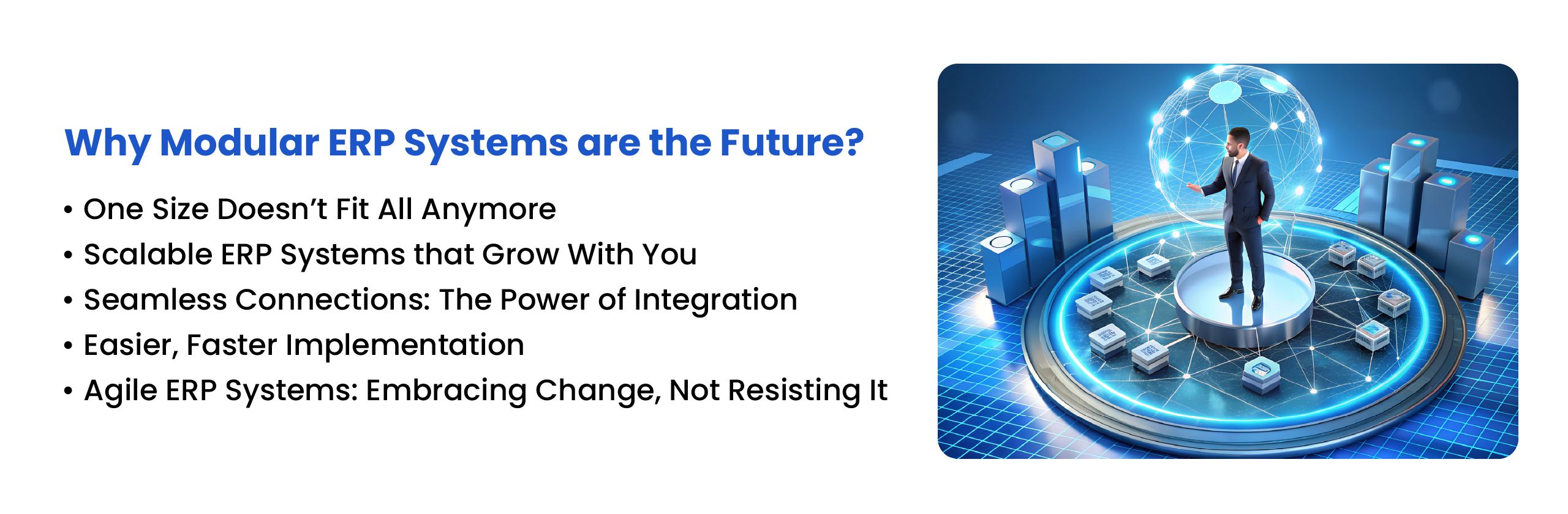
1. One-Size-Fits-All ERP No Longer Works
No two businesses operate in exactly the same way. A manufacturing company, ecommerce business, logistics provider, healthcare organization, and retail company may all need ERP software, but their workflows, data, approvals, reports, and integrations are very different.
Traditional ERP systems often force businesses to accept broad feature sets, many of which may not match the company’s actual needs. This can lead to unnecessary complexity, higher costs, slow adoption, and operational workarounds.
Modular ERP systems solve this problem by allowing companies to choose the modules that fit their current workflows. The business can start with what matters most and expand when needed.
2. Modular ERP Supports Scalable Growth
Business growth should not require a complete ERP replacement every few years. With scalable ERP architecture, companies can add new capabilities as their needs change.
A business may start with accounting and sales modules, then add inventory management, procurement, warehouse management, analytics, multi-location support, or customer portals as operations become more complex.
This makes modular ERP useful for growing companies because they can scale gradually instead of making a large upfront investment in features they may not need yet.
It also helps avoid the classic software tragedy: paying for ten modules, using three, and pretending the remaining seven are “strategic investments.” Humanity is very creative with invoices.
3. API-First Integration Makes ERP More Connected
Modern businesses use multiple systems across ecommerce, CRM, finance, warehouse management, payment gateways, shipping, analytics, customer service, and AI tools. ERP cannot operate as an isolated system anymore.
Modular ERP platforms work best when they are built with API-first integration. This allows different systems and modules to exchange data in real time, reduce duplicate entry, and automate workflows across departments.
With connected ERP modules, businesses can improve visibility across orders, inventory, finance, procurement, customer activity, and reporting.
4. Implementation Can Be Faster and Less Disruptive
Large ERP projects can become complex when every module, department, and workflow is implemented at once. Modular ERP allows businesses to take a phased approach.
Instead of launching the entire ERP system in one major rollout, companies can deploy priority modules first. For example, a business may begin with finance and inventory, then add procurement, CRM, warehouse management, or analytics later.
This can reduce implementation risk, shorten training time, and make adoption easier for employees. Teams learn the features that apply to their work instead of being overwhelmed by a large system from day one.
5. Modular ERP Makes Businesses More Agile
Business requirements change quickly. Companies may need to respond to new regulations, market expansion, customer expectations, supply chain issues, pricing models, or emerging technologies.
Agile ERP systems help businesses adapt without rebuilding the entire software environment. A modular ERP approach makes it easier to update workflows, add modules, connect new tools, and improve processes over time.
This is especially important for companies that want to modernize legacy ERP systems, connect disconnected departments, or introduce AI-powered reporting and automation into existing operations.
The Future of ERP: Key Trends and Predictions
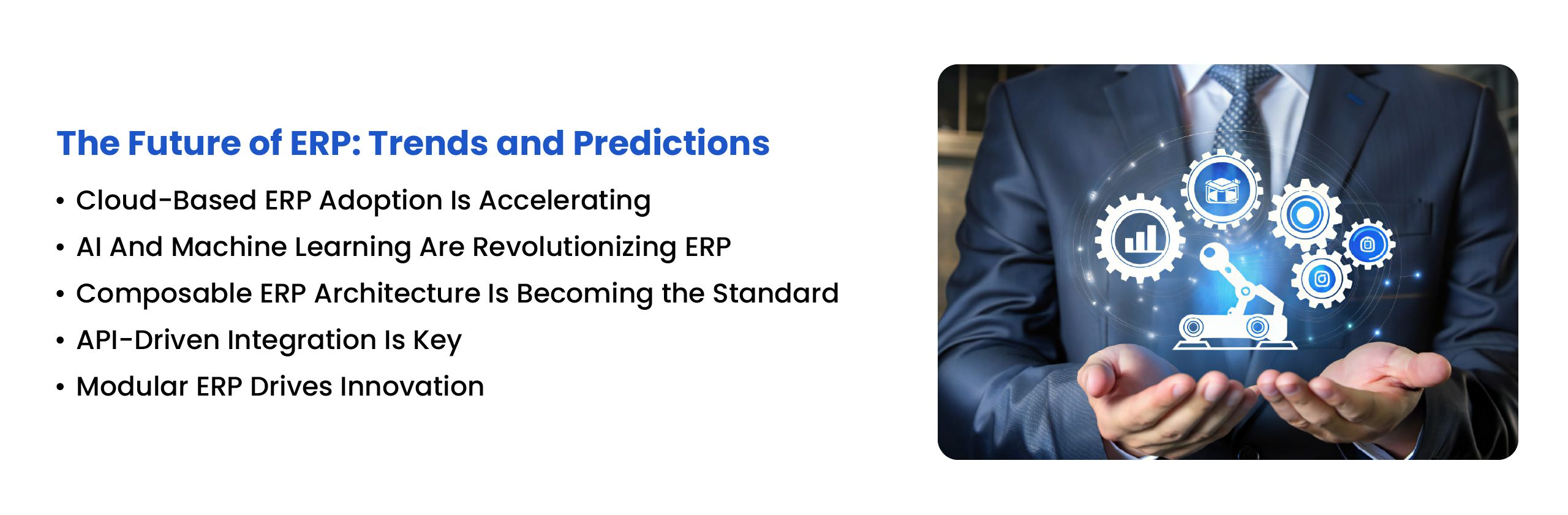
1. Cloud-Based ERP Adoption Will Continue to Grow
Cloud-based ERP systems make it easier for businesses to scale users, access systems remotely, reduce infrastructure overhead, and manage updates more efficiently.
For modular ERP, cloud deployment adds another advantage. Businesses can roll out modules gradually, support multiple locations, and connect cloud-based tools through APIs.
2. AI and Machine Learning Will Become Part of ERP Workflows
AI and machine learning are becoming more relevant inside ERP systems. Instead of sitting in separate dashboards, AI can support demand forecasting, anomaly detection, pricing recommendations, financial insights, inventory planning, and supply chain risk alerts.
Modular ERP makes AI adoption more practical because companies can add AI-powered capabilities where they create real value instead of forcing AI across the entire system at once.
3. Composable ERP Architecture Will Become More Important
Composable ERP architecture allows businesses to assemble ERP capabilities from different modules, services, and integrations. This gives companies more flexibility to replace, upgrade, or improve parts of the system without disrupting everything else.
This approach is useful for businesses that want ERP systems to evolve with their operations instead of becoming outdated and difficult to maintain.
4. API-Driven ERP Integration Will Be Essential
API-driven ERP integration helps businesses connect ERP with third-party applications, ecommerce platforms, CRMs, payment systems, warehouse systems, analytics platforms, and customer portals.
As companies use more specialized tools, ERP systems must become better at connecting data across the business. Modular ERP depends on clean integration because each module needs to work with the broader technology ecosystem.
5. Modular ERP Will Support Continuous Innovation
One of the biggest advantages of modular ERP is that it allows businesses to innovate gradually. Instead of waiting years for a full system upgrade, companies can improve specific modules, workflows, reports, or integrations as needs change.
This makes ERP more practical for businesses that want to test new technologies, improve internal processes, and respond faster to changing market conditions.
Modular ERP vs Monolithic ERP
Understanding the difference between modular and monolithic ERP helps businesses choose the right long-term architecture.
| Factor | Modular ERP | Monolithic ERP |
|---|---|---|
| Structure | Built with separate connected modules | Built as one large integrated system |
| Scalability | Modules can be added as needs grow | Scaling often requires larger system-wide changes |
| Implementation | Can be phased module by module | Often requires a larger rollout |
| Flexibility | Easier to customize and integrate gradually | Can be harder to change without affecting other areas |
| Best For | Growing companies, complex workflows, and businesses needing flexibility | Businesses with stable, standardized processes and limited customization needs |
Why Modular ERP Matters for Growing Businesses
For growing businesses, modular ERP matters because it reduces the pressure to solve every ERP problem at once. Companies can prioritize the most important workflows first and expand later.
This helps businesses control costs, reduce implementation risk, improve user adoption, and keep the ERP system aligned with operational changes.
Modular ERP also gives leadership teams better control over the ERP roadmap. Instead of being locked into a rigid system, they can decide which modules, integrations, and improvements should come next based on business value.
How NOI Technologies Helps Build Modular ERP Solutions
We help businesses choose which ERP modules to build first, connect them with existing tools, and add capabilities as operations grow. For NOGIN, we used Moqui to develop connected warehouse management, order management, and ecommerce capabilities. Learn more about our custom ERP development work.
We build modular ERP systems on open-source frameworks through Apache OFBiz development and Moqui development.
Final Thoughts
The future of ERP is modular because businesses need systems that are flexible, scalable, connected, and easier to adapt over time.
Instead of relying on rigid monolithic ERP platforms, companies can use modular ERP architecture to start with the features they need, add capabilities as they grow, and connect ERP with the broader business ecosystem.
For companies planning ERP modernization, open-source ERP development, or custom ERP implementation, modular ERP provides a practical path toward better flexibility, stronger integration, and long-term business control.
Need Help Building a Modular ERP System?
Talk to us about building a modular ERP, modernizing your current system, or connecting your tools through APIs.
FAQs About Modular ERP
What is modular ERP?
Modular ERP is an ERP system built with separate but connected modules for functions such as finance, inventory, CRM, HR, analytics, and warehouse management.
Why is modular ERP important?
Modular ERP is important because it helps businesses start with the modules they need, scale gradually, reduce implementation risk, and adapt the system as operations change.
How is modular ERP different from monolithic ERP?
Modular ERP uses separate connected modules, while monolithic ERP is built as one large system. Modular ERP is usually more flexible for phased implementation and future changes.
Can modular ERP support API integrations?
Yes. Modern modular ERP systems can use API-driven integration to connect with ecommerce platforms, CRM systems, payment tools, warehouse software, analytics, and AI applications.
Is modular ERP good for growing businesses?
Yes. Modular ERP is useful for growing businesses because they can add modules, users, workflows, and integrations as their needs expand.