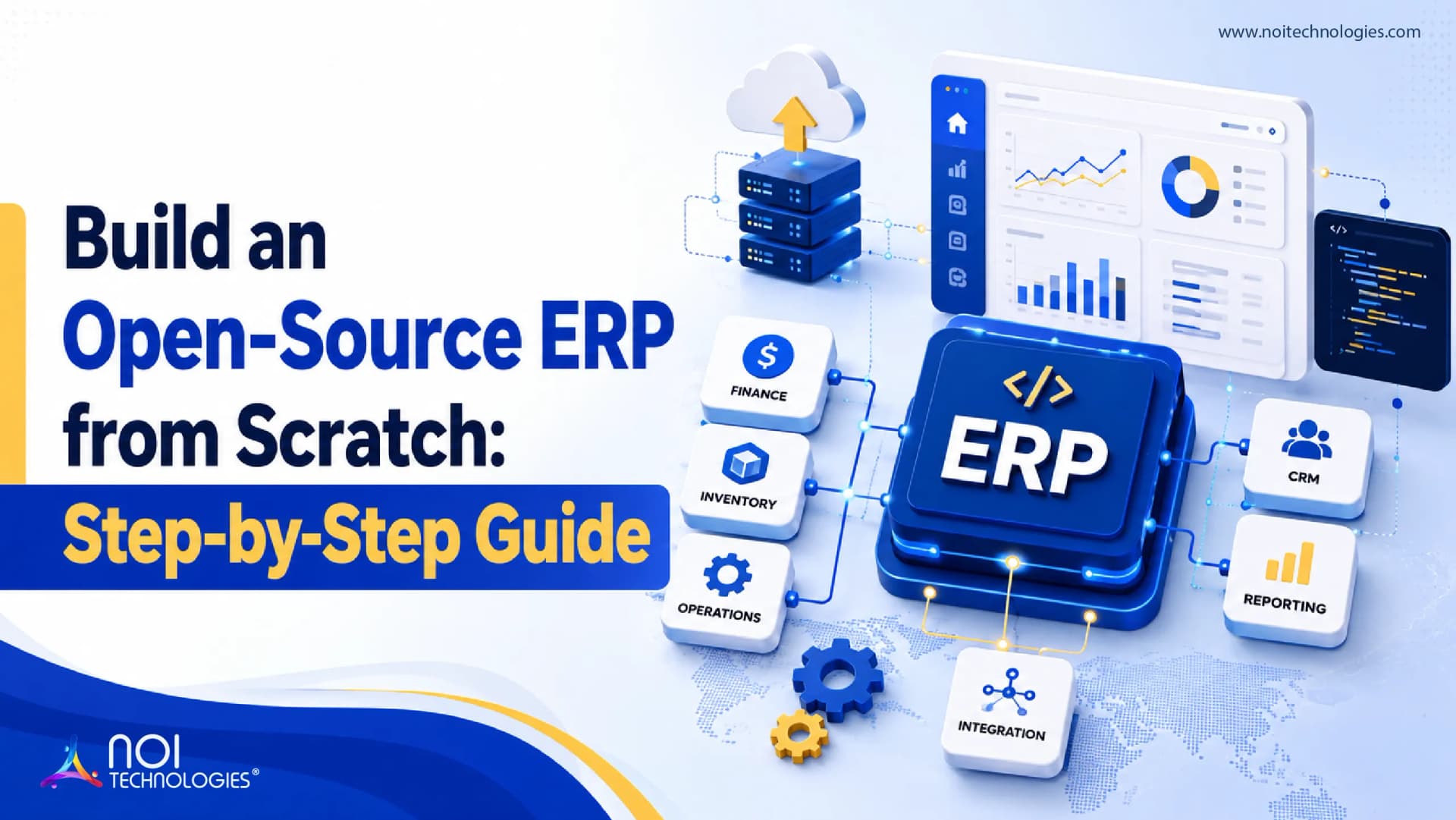
Developing an open-source ERP system can involve extending an existing ERP application, building custom modules on an enterprise framework, or developing a new application using open-source technologies. Each approach requires different decisions about architecture, reusable components, integrations, and long-term maintenance.
This guide explains how to plan and develop an open-source ERP system, including framework selection, application architecture, module development, integrations, testing, deployment, and ongoing support. It also examines when building from scratch makes sense and when an existing foundation is more practical.
What Is an Open-Source ERP System?
An open-source ERP system is enterprise resource planning software whose source code is available under an open-source license. Depending on the license, developers can inspect, modify, extend, and distribute the software to support specific business requirements.
These systems help organizations manage connected processes such as:
- Accounting and financial management
- Inventory and warehouse operations
- Procurement and supplier management
- Sales and customer management
- Manufacturing and production planning
- Human resources
- Reporting and business analytics
Platforms and frameworks such as Moqui Framework, Apache OFBiz, and ERPNext can provide a starting point for custom ERP development. The appropriate option depends on the required modules, architecture, integrations, deployment model, and customization needs.
Why Build on an Open-Source ERP Foundation?
Open-source technology can provide reusable components and greater control over application code, integrations, and deployment. Licensing costs vary by platform and edition, while development, hosting, security, and maintenance still require investment. Our guide to open-source ERP benefits and trade-offs explains these considerations.
Should You Build an ERP System Completely from Scratch?
Building every ERP component from the ground up can provide extensive control, but it also increases development time, cost, testing effort, and maintenance responsibility.
In many cases, businesses can use an established open-source ERP framework as the technical foundation and customize the modules, workflows, interfaces, and integrations they need.
A complete custom build may be appropriate when:
- The business has highly specialized workflows
- Available ERP platforms cannot support critical requirements
- The organization needs full control over the architecture
- The system will serve as a long-term strategic platform
- The business has the resources to maintain the software
Framework-based ERP development may be more practical when the organization wants to reuse established enterprise components while still creating a customized ERP solution.
Steps to Develop an Open-Source ERP System from Scratch
The open-source ERP software development process generally includes the following stages:
- Define business and system requirements.
- Plan the ERP development project.
- Select an open-source ERP framework and technology stack.
- Design the system architecture and user experience.
- Develop core ERP modules.
- Build integrations and automate data flows.
- Test the ERP system.
- Prepare documentation and train users.
- Deploy the ERP system.
- Maintain and improve the software.
1. Define Business and System Requirements
The first step is to identify what the ERP system must accomplish. Instead of beginning with a long feature list, document the business processes the software needs to support.
Requirements may include:
- Business workflows and approval processes
- User roles and access permissions
- ERP modules and functional capabilities
- Reporting and dashboard requirements
- Third-party integrations
- Data migration requirements
- Performance and scalability expectations
- Security and compliance requirements
- Mobile or handheld access
- Multi-company, multi-location, or multi-currency support
It is also important to distinguish essential requirements from features that can be introduced later. This helps control the initial project scope and supports a phased ERP implementation.
Identify the Required ERP Modules
The modules included in a custom open-source ERP system should reflect actual operational needs. Common modules include:
- Finance and accounting
- Inventory management
- Warehouse management
- Procurement
- Order management
- Customer relationship management
- Manufacturing and production planning
- Human resource management
- Asset management
- Business intelligence and reporting
Mapping dependencies between these modules at the beginning helps prevent fragmented workflows and duplicate data later.
2. Plan the ERP Development Project
Once the requirements are documented, create an ERP development roadmap. The plan should describe how the system will be designed, developed, tested, deployed, and supported.
The project plan should cover:
- Development phases and milestones
- Budget and resource allocation
- Project team responsibilities
- Technology and infrastructure decisions
- Data migration strategy
- Testing and quality assurance
- Training and deployment
- Post-launch support
A phased development model is often more manageable than building every ERP module at once. For example, a business may begin with finance, inventory, and order management before adding manufacturing, analytics, or industry-specific functions.
3. Choose the Right Open-Source ERP Framework and Technology Stack
The technology stack influences the ERP system's performance, scalability, security, maintainability, and integration capabilities.
Technology decisions usually include:
- Open-source ERP framework or application platform
- Back-end programming language
- Front-end framework
- Database technology
- API architecture
- Cloud or on-premises infrastructure
- Authentication and security tools
- Testing and monitoring tools
Choosing Between an ERP Application and an Enterprise Framework
An open-source ERP application and an enterprise application framework are not necessarily interchangeable starting points. An existing ERP application may provide business modules that can be configured or extended, while a framework provides reusable technical capabilities for developing applications around specific requirements.
| Starting Point | What Developers Can Reuse | What May Require Development |
|---|---|---|
| Existing open-source ERP application | Standard business modules, transactions, screens, and reports | Specialized workflows, integrations, extensions, and industry-specific functionality |
| Enterprise application framework | Data management, business services, security, workflow infrastructure, and application components | Application-specific modules, business rules, user interfaces, and integrations |
| Custom application using open-source libraries | Selected libraries, development tools, databases, and infrastructure components | Most domain-specific ERP functionality and integration between components |
4. Design the ERP Architecture and User Experience
ERP design involves both technical architecture and user experience. The system must support complex workflows without making routine tasks unnecessarily difficult.
Plan the System Architecture
The architecture should define how ERP modules, databases, APIs, integrations, security services, and user interfaces will interact.
Important architectural considerations include:
- Modular system design
- Data ownership and consistency
- API-first integration
- Role-based access control
- Audit trails
- Scalability and performance
- Backup and recovery
- Cloud deployment and infrastructure management
Design Practical ERP Interfaces
ERP screens should be designed around real user tasks. Employees should be able to locate records, complete approvals, enter data, review exceptions, and generate reports without navigating through unnecessary steps.
Wireframes and prototypes can be used to validate:
- Navigation structure
- Dashboard layouts
- Data-entry forms
- Search and filtering
- Approval workflows
- Mobile responsiveness
- Accessibility
Testing prototypes with actual users before development can reveal workflow problems that may otherwise become expensive to correct later.
5. Develop the Core ERP Modules
After the architecture and designs are approved, development can begin with the highest-priority modules.
Each module should include:
- Business rules
- Data models
- User permissions
- Approval processes
- Notifications
- Reports and dashboards
- Audit history
- API endpoints
Developers should avoid treating ERP modules as isolated applications. Finance, inventory, procurement, sales, warehouse management, and manufacturing processes often exchange data. The relationships between these modules need to be planned carefully.
Use a Phased ERP Development Approach
A minimum viable ERP implementation can include the essential modules needed to replace a specific manual or disconnected process. Additional functionality can then be introduced based on user feedback and operational priorities.
This approach can reduce implementation risk while allowing the development team to validate the system under real business conditions.
When developing on Apache OFBiz, teams can extend existing business applications and use its Entity Engine and Service Engine for data operations and business logic. With Moqui, developers can define entities, services, screens, and workflows using the framework's application components. The implementation work then focuses on connecting these capabilities to the business rules, modules, and interfaces the project requires.
6. Build ERP Integrations
Most modern ERP systems need to exchange information with external software. Common ERP integrations include:
- Ecommerce platforms
- Online marketplaces
- Payment gateways
- Shipping carriers
- Warehouse management systems
- Customer relationship management platforms
- Accounting applications
- Banking systems
- Business intelligence tools
- Electronic data interchange systems
Integration development should address data mapping, authentication, synchronization frequency, validation, error handling, duplicate prevention, and retry processes.
For important transactions, the ERP system should record whether information was transmitted successfully and provide a clear process for resolving failed integrations.
7. Test the ERP System Thoroughly
ERP testing should verify that individual functions work correctly and that complete business processes operate reliably across modules.
Types of ERP Testing
- Unit testing: Verifies individual components, services, and business rules.
- Integration testing: Confirms that modules and external systems exchange data correctly.
- Functional testing: Checks whether features meet the documented requirements.
- Workflow testing: Tests complete processes such as order-to-cash or procure-to-pay.
- Performance testing: Measures response times, transaction handling, and system behavior under load.
- Security testing: Evaluates access controls, authentication, vulnerabilities, and data protection.
- Data migration testing: Verifies the accuracy and completeness of imported records.
- User acceptance testing: Allows business users to confirm that the system supports real operational needs.
Testing should use realistic scenarios, user roles, transaction volumes, and data conditions. ERP software may appear stable during isolated feature testing while still failing when several modules and integrations operate together.
8. Deploy the ERP System
Before deployment, prepare the production environment, migrate approved data, configure integrations, create user accounts, and verify backup and recovery procedures.
Deployment may follow one of several approaches:
- Phased deployment: Introduces the ERP system by module, department, or location.
- Pilot deployment: Launches the system with a smaller user group before wider adoption.
- Parallel deployment: Runs the old and new systems together temporarily.
- Full deployment: Replaces the existing system across the organization at once.
The appropriate deployment strategy depends on operational risk, system complexity, data quality, business size, and the availability of support resources.
9. Provide Documentation and User Training
Even well-designed ERP software can fail to deliver value when users do not understand how to use it.
Documentation should cover:
- Daily user procedures
- Administrative configuration
- Approval workflows
- Reporting processes
- Integration management
- Troubleshooting steps
- Security responsibilities
- Backup and recovery procedures
Training should be based on user roles. Finance teams, warehouse employees, sales users, system administrators, and managers may require different training materials and practical exercises.
10. Maintain and Improve the ERP Software
Open-source ERP development does not end after deployment. The system requires ongoing monitoring, security updates, bug fixes, performance optimization, integration maintenance, and functional improvements.
Post-launch ERP maintenance may include:
- Monitoring application performance
- Installing security updates
- Reviewing system logs
- Resolving user-reported issues
- Updating third-party integrations
- Optimizing database performance
- Adding reports and workflow improvements
- Reviewing access permissions
- Testing framework and infrastructure upgrades
A structured maintenance process helps keep the open-source ERP system secure, reliable, and aligned with changing business requirements.
Common Challenges in Open-Source ERP Development
Businesses should prepare for several common implementation challenges:
- Unclear or changing requirements
- Excessive customization
- Poor-quality legacy data
- Complex third-party integrations
- Limited user involvement
- Insufficient testing
- Weak documentation
- Underestimated support requirements
- Difficulty upgrading heavily modified systems
These risks can be reduced through phased planning, documented requirements, modular architecture, realistic testing, and consistent involvement from business users.
Conclusion
Developing an open-source ERP system from scratch requires coordinated work across business analysis, software architecture, module development, integration, testing, data migration, training, deployment, and ongoing maintenance.
The process should begin with clearly defined operational requirements rather than a generic list of ERP features. Businesses should then evaluate whether a fully custom system or an established open-source ERP framework provides the most practical foundation.
A well-planned custom open-source ERP solution can give an organization greater control over workflows, integrations, data, and future system development. Its long-term success, however, depends on disciplined implementation and continued technical support.
NOI Technologies used Moqui as the foundation for Fulfillor, its 3PL warehouse management system. This illustrates how an enterprise framework can support a specialized operational application.
Planning an Open-Source ERP Project?
NOI Technologies provides open-source ERP development and consulting for businesses that need custom modules, workflows, integrations, and enterprise application architecture.