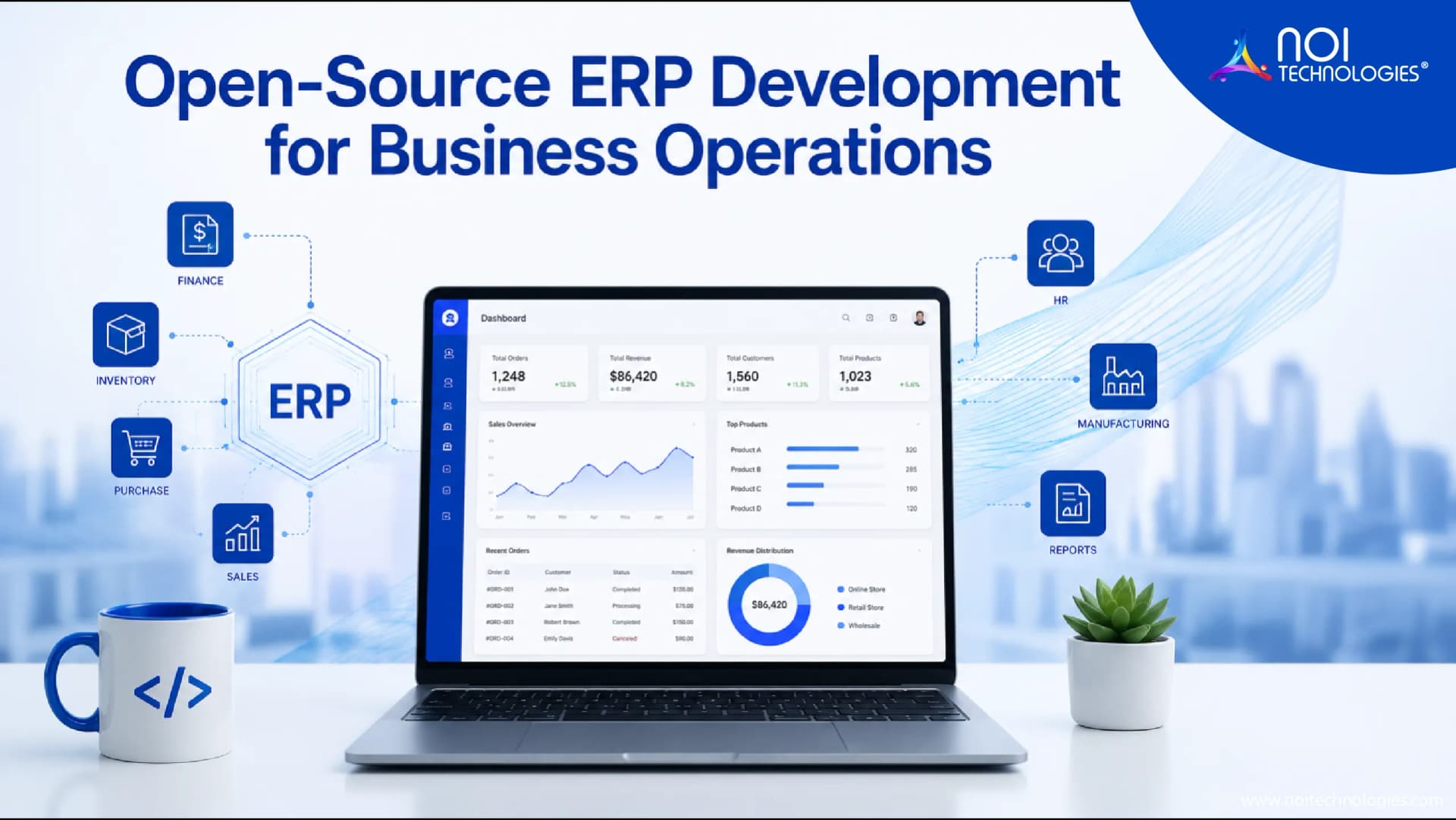
Modern businesses need connected systems to manage finance, inventory, procurement, sales, supply chain, manufacturing, logistics, customer data, and reporting. When these functions are handled through disconnected tools or manual processes, teams often deal with duplicate data, slow approvals, reporting gaps, and limited visibility.
Open-source ERP development helps businesses build ERP systems around their actual operations. Instead of depending only on fixed proprietary software, companies can customize open-source ERP platforms to support specific workflows, integrations, reporting needs, and industry requirements.
An open-source ERP system can help businesses automate routine tasks, centralize data, improve collaboration, and make operations easier to manage as the company grows.
This article explains what ERP is, the key components of an open-source ERP system, and the main benefits of using open-source ERP development for business operations.
What Is ERP?
ERP stands for enterprise resource planning. It is a software system that helps organizations manage core business activities from one connected platform. These activities may include finance, procurement, inventory, customer management, supply chain, risk management, compliance, manufacturing, order management, and reporting.
An ERP system helps different departments work from shared data instead of isolated spreadsheets or disconnected software. This improves coordination between teams and gives management better visibility into business performance.
ERP systems can be deployed in different ways, including on-premise ERP, cloud-based ERP, and hybrid ERP models. The right model depends on the company’s infrastructure, security requirements, budget, customization needs, and long-term growth plans.
Open-source ERP options include products and enterprise application frameworks with different capabilities and implementation requirements. Our comparison of open-source ERP platforms and frameworks explains those differences.
Explore More Open-Source ERP Insights
Read more articles on open-source ERP systems, ERP development, enterprise software, and business process automation.
Key Components of an Open-Source ERP System
An open-source ERP system usually includes several business modules that work together to manage core operations. The exact modules depend on the industry, business model, and implementation scope.

The main components often include:
- Customer relationship management
- Finance and accounting
- Human resource management
- Manufacturing and logistics
- Supply chain management
Customer Relationship Management
Customer relationship management, or CRM, helps businesses manage customer data, sales activity, communication history, purchase behavior, and service interactions.
When CRM is connected with ERP, teams can get a clearer view of customer activity across sales, billing, inventory, order fulfillment, and support. This helps businesses improve customer service, identify repeat buying patterns, and manage sales opportunities more effectively.
Finance and Accounting
Finance is one of the core ERP modules because it connects directly with business performance. An ERP finance module can help manage accounts receivable, accounts payable, general ledger, budgeting, recurring costs, invoicing, payments, tax data, and financial reporting.
With centralized financial data, businesses can track cash flow, reduce manual accounting work, improve reporting accuracy, and support better decision-making.
Human Resource Management
Human resource management, also known as human capital management, helps businesses manage employee-related processes. This may include employee records, attendance, payroll, performance reports, leave management, role structures, and internal approvals.
When HRM is connected with ERP, companies can reduce manual HR tasks and improve visibility across workforce-related data.
Manufacturing and Logistics
Manufacturing and logistics modules help businesses manage production planning, work orders, raw materials, inventory movement, packing, shipping, and delivery workflows.
For companies with complex production or distribution operations, ERP can help connect manufacturing, warehouse, logistics, and order management processes. This improves visibility into production status, stock availability, fulfillment progress, and delivery timelines.
ERP can also help companies address logistics data challenges by connecting order, inventory, and fulfillment information in one system.
Supply Chain Management
Supply chain management helps businesses manage procurement, supplier data, inventory flow, production requirements, distribution planning, and demand-related decisions.
A connected ERP system can help teams track materials, monitor supply availability, manage purchase orders, and improve coordination between suppliers, warehouses, production teams, and customers.
Other ERP modules may include inventory management, ecommerce, marketing automation, warehouse management, order management, project management, procurement, and reporting.
Benefits of Open-Source ERP Development for Businesses

Open-source ERP development gives businesses more control over how their ERP system is designed, customized, integrated, and maintained. This is especially useful for companies with workflows that standard ERP software cannot fully support.
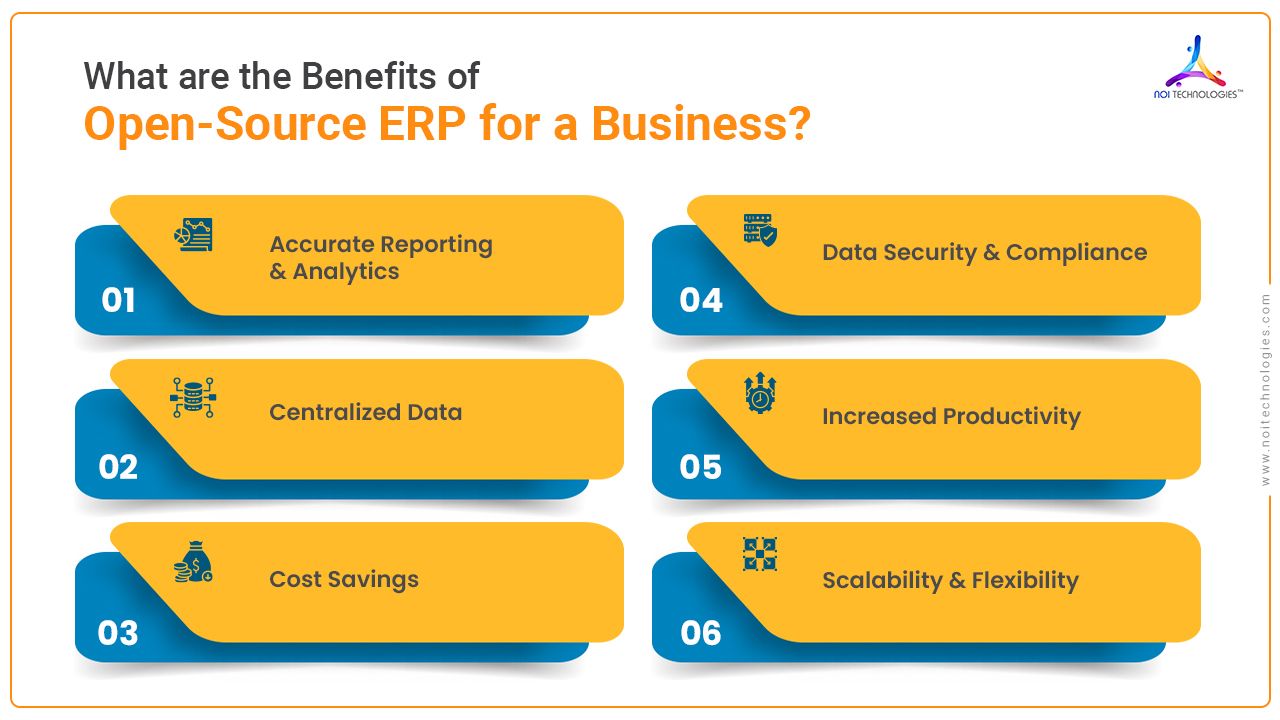
Some of the main benefits include:
- Accurate reporting and analytics
- Centralized business data
- Better cost control
- Data security and compliance support
- Improved productivity
- Scalability and flexibility
Accurate Reporting and Analytics
Open-source ERP systems can be customized to provide reports based on specific business requirements. These reports may cover sales, inventory, finance, procurement, customer activity, production, warehouse performance, or supply chain operations.
Instead of relying on separate reports from different departments, businesses can use centralized ERP data to identify trends, monitor performance, and make more informed decisions.
Centralized Business Data
ERP helps businesses manage data in one connected system. This reduces the problems caused by duplicate records, outdated spreadsheets, and disconnected department-level tools.
Centralized data helps teams access more accurate information when managing orders, inventory, invoices, customers, suppliers, employees, and operations. It also improves collaboration because departments can work from the same source of information.
Better Cost Control
Open-source ERP development can help reduce costs by automating repetitive work, improving process visibility, and reducing dependency on manual data entry.
Businesses can also avoid some of the licensing limitations often associated with proprietary ERP software. However, implementation, customization, hosting, support, and maintenance still require proper planning and investment.
The real cost advantage comes from building an ERP system that fits the business process instead of forcing teams to rely on inefficient workarounds.
Data Security and Compliance Support
ERP systems often handle sensitive business data, including financial records, customer details, employee information, inventory data, and operational reports. Security must be planned carefully during implementation.
Open-source ERP gives technical teams more visibility into the system architecture and codebase. With proper access controls, authentication, hosting, backups, updates, and audit trails, businesses can build a more secure ERP environment.
ERP systems can also support compliance by improving documentation, approval tracking, financial records, and data visibility across business processes.
Improved Productivity
ERP improves productivity by reducing repetitive manual work and helping teams complete tasks through defined workflows. This may include automated approvals, inventory updates, invoice generation, order processing, reporting, and internal notifications.
When teams spend less time searching for data or repeating the same manual tasks, they can focus more on work that supports customers, operations, and business growth.
Scalability and Flexibility
Open-source ERP development gives businesses the flexibility to build custom workflows, add modules, connect third-party systems, and adapt the ERP as operations change.
This is useful for companies that are expanding into new locations, adding product lines, managing more users, increasing order volume, or connecting multiple business systems.
A scalable ERP system helps businesses support growth without rebuilding their entire software environment each time operations become more complex.
Why Businesses Choose Open-Source ERP Development
Open-source ERP development is often a strong fit for businesses that need more customization than standard ERP platforms provide. It allows companies to build workflows around real operational needs instead of adjusting every process to match a fixed software product.
This approach is especially useful for manufacturing, logistics, ecommerce, distribution, retail, and service-based companies with complex processes, multiple departments, or integration-heavy operations.
With the right ERP implementation partner, businesses can use open-source ERP frameworks to create systems that support long-term operational growth. NOI Technologies supports these projects through Moqui ERP development and Apache OFBiz development and support.
Conclusion
Open-source ERP development helps businesses connect departments, automate workflows, improve reporting, manage data more accurately, and build systems around their actual processes.
For companies with complex operations, an open-source ERP system can provide the flexibility needed to support customization, integration, scalability, and long-term system ownership.
NOI Technologies helps businesses assess workflows, integrations, customization requirements, and long-term support needs. Explore our custom ERP development services for help planning a system around your operations.
Need Help With Open-Source ERP Development?
Talk to NOI Technologies about building or improving an ERP system around your business workflows.