Manufacturing companies need more than basic accounting or inventory software. Production planning, material availability, purchasing, work orders, warehouse activity, quality checks, sales, and financial data must work together.
An open-source ERP system can help manufacturers connect these processes while retaining greater control over customization, integrations, hosting, and system architecture. However, open-source platforms differ significantly. Some provide ready-to-use manufacturing modules, while others serve as frameworks for building applications around specialized production workflows.
This guide compares five open-source ERP solutions for manufacturing based on production capabilities, customization, implementation requirements, technical complexity, and business fit.
Why Manufacturers Consider Open-Source ERP Software
Manufacturing processes rarely remain simple as a business grows. Product variants increase, supplier relationships become more complicated, inventory moves across multiple locations, and production teams need accurate information about materials, schedules, and customer demand.
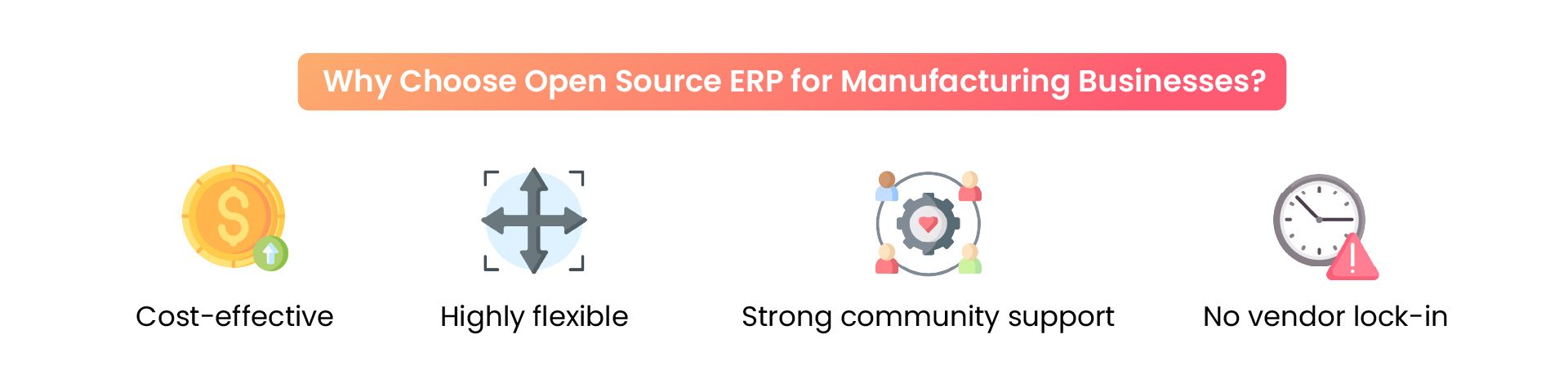
Open-source ERP software can help manufacturers:
- Connect purchasing, inventory, production, sales, and finance
- Adapt workflows to specific manufacturing requirements
- Integrate ERP functions with ecommerce, logistics, and legacy systems
- Maintain greater control over source code and deployment
- Reduce dependence on a single proprietary software vendor
Open-source software does not mean implementation is free. Businesses must still account for consulting, development, hosting, migration, training, support, security, and maintenance. The main advantage is greater flexibility in how the system is implemented and extended.
Best Open-Source ERP Solutions for Manufacturing
The following platforms support manufacturing in different ways. The right choice depends on whether the company needs packaged ERP functions, extensive customization, or a framework for developing a more specialized system.

1. Apache OFBiz
Apache OFBiz is an open-source suite of enterprise applications and a development framework. It includes components for product management, inventory, purchasing, order management, accounting, manufacturing, ecommerce, and other business functions.
OFBiz is not typically a plug-and-play manufacturing ERP. It provides a foundation that implementation teams can configure and extend around business requirements.
For a closer look at its production features, see how Apache OFBiz handles MRP, bills of materials, and production workflows.
Manufacturing capabilities
- Product and catalog management
- Bill of materials support
- Manufacturing and production-related processes
- Inventory and warehouse management
- Procurement and supplier management
- Order management and accounting integration
When Apache OFBiz is a good fit
Apache OFBiz may suit manufacturers that need a highly customizable ERP architecture and have access to experienced Java developers or an implementation partner.
It can be useful when standard ERP modules cannot support specific product structures, approval processes, fulfillment rules, pricing models, or integrations.
Businesses should expect a structured implementation process that includes discovery, configuration, development, data migration, testing, training, and ongoing maintenance.
2. Moqui Framework
Moqui Framework is an open-source enterprise application framework. Unlike a packaged ERP suite, it is primarily used to build custom business applications and connected enterprise systems.
Moqui provides tools for data management, business services, workflows, screens, security, reporting, and system integrations. Development teams can use these components to create manufacturing, inventory, order management, accounting, ecommerce, or warehouse applications around specific operational requirements.
Manufacturing capabilities
Moqui does not provide the same ready-made manufacturing experience as a traditional ERP product. Its value lies in supporting the development of customized processes such as:
- Production planning workflows
- Custom material allocation rules
- Specialized bills of materials
- Inventory reservation and replenishment logic
- Supplier and purchase-order automation
- Quality-control and approval workflows
- Integration with warehouse, logistics, and ecommerce systems
When Moqui is a good fit
Moqui may be suitable for manufacturers whose operations cannot be represented accurately through standard ERP modules. It can also support businesses that want to develop several connected applications on a shared architecture.
Because Moqui is developer-focused, implementation normally requires technical planning and experienced development resources. It is less appropriate for companies seeking a manufacturing ERP that can be installed and used with minimal customization.
3. Odoo
Odoo is a modular ERP platform with applications for manufacturing, inventory, purchasing, sales, accounting, maintenance, quality management, human resources, customer relationship management, and ecommerce.
Its modular structure allows businesses to begin with selected applications and add more capabilities as their requirements grow.
Manufacturing capabilities
- Bills of materials
- Manufacturing orders
- Work centers and operations
- Inventory and replenishment
- Maintenance management
- Quality-related workflows
- Purchasing and sales integration
When Odoo is a good fit
Odoo may work well for small and mid-sized manufacturers that need a packaged ERP system with connected business applications.
It can provide a faster starting point when the company’s processes align with available modules. More specialized workflows may require configuration, custom development, or third-party applications.
Businesses should compare the capabilities and costs of the available Odoo editions carefully. The total cost may include licensing, hosting, implementation, migration, customization, support, and future upgrades.
4. ERPNext
ERPNext is an open-source ERP suite designed for businesses that need integrated accounting, sales, purchasing, inventory, manufacturing, customer management, human resources, and project functions.
Its manufacturing features provide a practical starting point for small and mid-sized manufacturers that want packaged functionality without building an ERP system from the ground up.
Manufacturing capabilities
- Bills of materials
- Work orders
- Production planning
- Material requests and transfers
- Subcontracting workflows
- Inventory and warehouse management
- Quality inspection processes
When ERPNext is a good fit
ERPNext may suit manufacturers with relatively standard production, purchasing, inventory, and accounting requirements.
It can be considered by companies moving away from spreadsheets or disconnected applications and looking for an integrated ERP suite. Businesses with highly specialized manufacturing processes should assess whether the platform can be configured appropriately without creating excessive customization.
5. Tryton
Tryton is an open-source business application platform with modules for accounting, sales, purchasing, inventory, production, project management, and other business functions.
Its modular architecture allows organizations to select the components they need and extend the system through additional development.
Manufacturing capabilities
- Production orders
- Bills of materials
- Inventory and stock movements
- Purchasing and supplier management
- Sales and order processing
- Multi-company and multi-currency operations
When Tryton is a good fit
Tryton may be appropriate for organizations that want a modular business system and are comfortable working with technical implementation resources.
Manufacturers should evaluate the available modules and required custom development carefully. Its suitability will depend on production complexity, reporting requirements, local accounting needs, and integration scope.
Open-Source Manufacturing ERP Comparison
| Platform | Platform Type | Manufacturing Approach | Customization Level | Technical Requirement | Best Fit |
|---|---|---|---|---|---|
| Apache OFBiz | ERP suite and development framework | Configured and extended around business requirements | Very high | High | Complex manufacturing and enterprise workflows |
| Moqui Framework | Enterprise application framework | Custom manufacturing applications | Very high | High | Specialized processes and custom system development |
| Odoo | Modular ERP suite | Ready-made applications with configuration options | Moderate to high | Medium | Small and mid-sized manufacturers |
| ERPNext | Integrated ERP suite | Packaged manufacturing functions | Moderate | Medium | SMEs with standard production requirements |
| Tryton | Modular business application platform | Module-based production management | High | Medium to high | Organizations seeking modular control |
How to Choose an Open-Source ERP for Manufacturing
Feature lists alone do not determine whether an ERP system will work in a production environment. The platform must support the way materials, people, machines, suppliers, warehouses, and customer orders interact.
Document the production process
Map how demand becomes a production order, how materials are reserved, how work is assigned, how completed goods are recorded, and how production costs are calculated.
This process helps identify where standard modules are sufficient and where customization may be necessary.
Evaluate manufacturing depth
Confirm whether the system supports the production functions your business actually uses. These may include:
- Single-level or multi-level bills of materials
- Batch, process, discrete, or make-to-order manufacturing
- Work centers and routing
- Capacity and production planning
- Lot and serial traceability
- Quality inspections
- Scrap, rework, and by-product handling
- Subcontract manufacturing
Review integration requirements
A manufacturing ERP may need to exchange data with ecommerce platforms, warehouse systems, shipping providers, supplier portals, accounting tools, machines, barcode systems, or existing databases.
Evaluate how each integration will be developed, monitored, secured, and maintained.
Consider internal technical resources
Framework-based platforms such as Moqui and Apache OFBiz offer substantial flexibility, but they require experienced technical teams. Packaged systems such as Odoo and ERPNext may reduce initial development work when standard modules cover most requirements.
Calculate total ownership cost
Compare more than software licensing. Include:
- Implementation and consulting
- Custom development
- Hosting and infrastructure
- Data migration
- User training
- Support and maintenance
- Security updates
- Future upgrades
Which Open-Source Manufacturing ERP Is Right for Your Business?
There is no single open-source ERP platform that is suitable for every manufacturer.
Odoo and ERPNext may provide a more direct route for companies that need established manufacturing functions and want to configure an existing ERP suite.
Apache OFBiz may suit organizations that need an extensible enterprise platform with ERP components and substantial control over system development.
Moqui may be appropriate when the business needs a custom manufacturing or enterprise application built around specialized processes rather than conventional ERP modules.
Tryton can be considered by organizations seeking a modular platform that can be assembled and extended through technical implementation.
The final decision should be based on production requirements, technical resources, integration needs, implementation timeline, and long-term ownership costs.
Need Help Choosing a Manufacturing ERP?
For MPStyle, we built a fashion manufacturing ERP on Apache OFBiz. We can help you map your production requirements and assess whether an existing ERP system or a custom manufacturing ERP is the better fit.
Schedule a consultation to discuss your manufacturing ERP requirements.