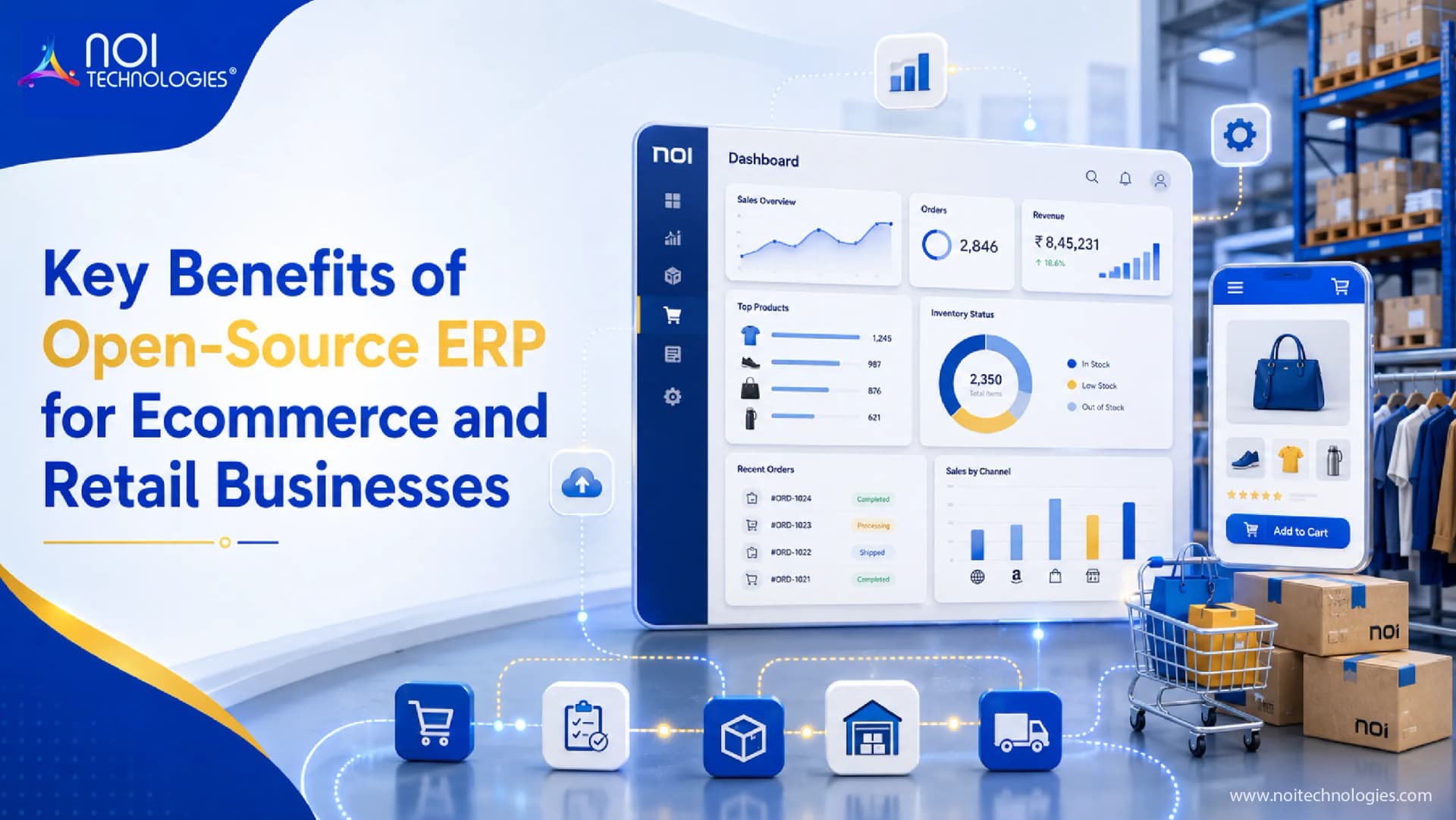
Ecommerce businesses often manage orders, inventory, payments, suppliers, returns, accounting, fulfillment, and customer data across several systems. As order volume and sales channels grow, disconnected applications can create inventory mismatches, delayed updates, duplicate work, and reporting gaps.
An open-source ERP can provide a central operational layer for these processes while giving businesses the flexibility to customize workflows and integrations around their ecommerce model.
This article explains how open-source ERP can support ecommerce operations, where it provides the most value, which systems typically connect with it, and when it makes sense compared with relying on separate ecommerce applications.
What Is Open-Source ERP for Ecommerce?
Open-source ERP for ecommerce is an enterprise resource planning system or framework that connects ecommerce operations such as orders, inventory, purchasing, finance, fulfillment, returns, and reporting while providing access to the underlying source code.
The ERP does not replace every ecommerce application. The storefront, marketplace, payment provider, shipping platform, or warehouse system may remain in place while the ERP manages shared business data and processes across them.
For example, an online store may continue using its ecommerce platform for product discovery, checkout, and payments while the ERP receives confirmed orders, updates inventory, manages purchasing, coordinates fulfillment, records financial transactions, and produces operational reports.
Why Ecommerce Businesses Use ERP
Ecommerce operations become harder to manage when each function maintains its own version of the same business data.
An ecommerce platform may know which order was placed. A warehouse system may know what was picked. Accounting may know what was invoiced. A procurement tool may know what is being reordered. Customer support may be looking at another system entirely.
ERP creates a shared operational layer where these transactions can be connected.
The value becomes more noticeable as the business adds marketplaces, warehouses, suppliers, product lines, currencies, or higher order volumes.
Core Ecommerce Processes an ERP Can Support
| Ecommerce Process | ERP Role |
|---|---|
| Order Management | Receives orders, applies business rules, tracks status, and connects orders with inventory, fulfillment, invoicing, and returns. |
| Inventory Management | Maintains stock information across facilities and supports allocation, adjustments, transfers, and replenishment. |
| Procurement | Manages suppliers, purchase orders, expected receipts, purchasing approvals, and replenishment requirements. |
| Finance | Connects sales, refunds, purchasing, inventory, payments, and other transactions with financial records and reporting. |
| Fulfillment | Coordinates order release, warehouse activity, shipment status, and fulfillment information. |
| Returns | Tracks return requests, received items, inventory disposition, refunds, replacements, and related financial transactions. |
| Reporting | Combines operational and financial data across channels for analysis and decision-making. |
Benefits of Open-Source ERP for Ecommerce Businesses
Connected Order and Inventory Data
Inventory accuracy becomes difficult when orders arrive from several channels while stock is maintained separately.
An ERP can connect orders with inventory movements so teams have a clearer view of what is available, allocated, received, transferred, shipped, or returned.
This can reduce situations where one channel continues accepting orders for stock that has already been committed elsewhere.
Better Support for Multichannel Ecommerce
Many ecommerce businesses sell through more than one channel. A company may operate its own website while also selling through marketplaces or other digital channels.
The ERP can act as a shared backend for product, order, inventory, purchasing, and financial processes while individual channels continue handling their customer-facing functions.
This creates a more consistent operational model without requiring every channel to manage business logic independently.
More Control Over Ecommerce Integrations
Ecommerce operations commonly depend on integrations with storefronts, marketplaces, payment providers, warehouse systems, shipping platforms, CRM applications, accounting tools, and supplier systems.
Open-source ERP allows development teams to build or modify integration logic when standard connectors do not support the required workflow.
That flexibility becomes important when integration rules involve custom order statuses, inventory ownership, customer-specific pricing, marketplace mappings, fulfillment rules, or exception handling.
Improved Purchasing and Replenishment
Order growth affects purchasing as well as fulfillment.
When sales, inventory, open purchase orders, supplier lead times, and stock requirements are connected, purchasing teams have better information for replenishment decisions.
The ERP can also maintain supplier records, purchase orders, receiving information, pricing, and approval workflows in the same environment used for inventory and order operations.
More Consistent Financial Data
Ecommerce finance involves more than recording sales revenue. Businesses may need to account for refunds, discounts, taxes, payment fees, marketplace transactions, supplier costs, inventory value, shipping charges, and other operational activity.
ERP can connect these transactions with financial records rather than requiring finance teams to reconstruct activity from separate systems at the end of a reporting period.
Better Returns Handling
Returns affect customer service, inventory, fulfillment, and finance at the same time.
A connected ERP workflow can record the return request, identify the original order, track receipt of the item, determine whether it returns to available inventory, and connect the return with the appropriate refund or replacement process.
This is particularly useful when returns originate from different ecommerce channels but need to follow common operational rules.
Operational Reporting Across Channels
Ecommerce teams need more than sales totals.
Useful operational reporting may include inventory availability, order backlog, supplier performance, return rates, fulfillment status, purchasing requirements, channel activity, and financial performance.
ERP can provide a shared data source for these reports when the underlying transactions are connected properly.
How Ecommerce ERP Integrations Should Work
ERP integrations need more than a connection between two APIs. Each system needs a defined responsibility.
For an ecommerce order, for example, the storefront may own checkout while the ERP becomes responsible after the order is confirmed. The integration then needs rules for cancellations, address changes, fulfillment updates, inventory changes, refunds, and errors.
The same principle applies to marketplaces.
Teams should determine:
- which system creates the original record;
- which system is the source of truth after creation;
- which events need immediate synchronization;
- which updates can be processed asynchronously;
- how duplicate events are prevented;
- how failed transactions are retried; and
- how teams can identify and resolve integration errors.
Without these rules, adding more integrations can increase operational complexity instead of reducing it.
Open-Source ERP for Marketplace Sellers
Marketplace sellers often need to process orders from several platforms while maintaining consistent inventory, purchasing, fulfillment, and financial processes.
An ERP can receive marketplace orders and convert them into a common internal workflow rather than allowing every marketplace to create a separate operating process.
This is useful when marketplaces use different product identifiers, status values, fees, shipping requirements, or transaction structures.
The ERP can provide the internal data model while integration logic translates information between the marketplace and the business's operational systems.
Our custom order management system guide explains how multichannel orders can be allocated, routed, and coordinated with fulfillment.
Open-Source ERP for Inventory and Fulfillment
Inventory is one of the most important ERP functions for ecommerce because product availability affects purchasing, sales, fulfillment, returns, and customer experience.
The ERP can maintain inventory by location and track events such as receipts, allocations, transfers, adjustments, shipments, and returns.
Businesses using a dedicated WMS do not necessarily need to replace it. The ERP can remain responsible for broader inventory ownership, purchasing, orders, and finance while the WMS manages detailed warehouse execution.
The integration should define which system owns each inventory event and how stock changes are synchronized.
How Open-Source ERP Supports Ecommerce Returns
Returns are often handled poorly when ecommerce, warehouse, customer-service, and finance systems do not share the same transaction history.
An ERP can connect the return to the original order and track what happens after the product comes back.
The workflow may need to record:
- the reason for return;
- the item and quantity returned;
- the receiving location;
- the condition of the item;
- whether inventory can be made available again;
- whether a replacement is required; and
- which refund or financial adjustment should be created.
The exact workflow varies by business model, but maintaining these events in a connected process reduces manual reconciliation between teams.
When Does Open-Source ERP Make Sense for Ecommerce?
Open-source ERP becomes more relevant when ecommerce operations have moved beyond a small number of simple, disconnected workflows.
It is worth evaluating when a business has several sales channels, complex inventory requirements, multiple warehouses, significant purchasing activity, custom fulfillment logic, marketplace integrations, or reporting requirements that cannot be handled cleanly by the existing ecommerce stack.
It can also make sense when the company needs more control over integrations or business rules than standard SaaS applications allow.
For a small ecommerce business using one storefront, one fulfillment workflow, and basic accounting, a full ERP implementation may add unnecessary complexity. The system should solve a real operational problem rather than being introduced simply because the company is growing.
When Open-Source ERP May Not Be the Right Fit
Source-code access creates flexibility, but it also creates technical responsibility.
An open-source ERP implementation may require development, infrastructure management, security updates, integration maintenance, testing, documentation, and ongoing support.
A business that needs a simple plug-and-play application and does not have access to technical resources may be better served by standard ecommerce software until its operations require deeper integration or customization.
The decision should be based on operational complexity and required control, not on the assumption that open-source software is automatically cheaper.
Open-Source ERP Frameworks for Ecommerce Development
Apache OFBiz
Apache OFBiz provides an open-source enterprise application framework and business applications covering areas such as ecommerce, order management, accounting, inventory, manufacturing, and related enterprise processes.
It can provide a foundation for ecommerce businesses that need ERP functionality connected with order, inventory, fulfillment, purchasing, and financial workflows.
Our guide to Apache OFBiz features for ecommerce explains its commerce capabilities in more detail.
Moqui Framework
Moqui Framework provides enterprise application capabilities for entities, services, screens, workflows, security, and business applications.
It can be used for ecommerce ERP projects that require custom business logic, integrations, and modular enterprise applications.
Open-Source ERP for Ecommerce vs Retail ERP
Ecommerce ERP and retail ERP share some functions, particularly inventory, purchasing, finance, and order management, but the operating environments are different.
Ecommerce ERP places greater emphasis on digital sales channels, marketplace integrations, online orders, fulfillment, payment data, returns, and synchronization between ecommerce platforms and backend systems.
Retail ERP may place more emphasis on physical stores, point-of-sale systems, store replenishment, merchandising, store inventory, and coordination between retail locations.
Businesses operating both models may use the same ERP foundation, but the implementation requirements should account for the different workflows.
How NOI Technologies Supports Ecommerce ERP Development
NOI Technologies develops enterprise systems that connect ecommerce, order management, inventory, fulfillment, and related business workflows.
Projects may involve extending an existing open-source ERP, developing custom ecommerce workflows, connecting marketplaces or storefronts, integrating warehouse and shipping systems, or building new enterprise functionality on an open-source framework.
Businesses evaluating a broader ERP development engagement can review our Custom ERP Development Services.
For NOGIN, NOI Technologies developed connected WMS, OMS, and ecommerce capabilities using the Moqui Framework. The project connected order, inventory, warehouse, and commerce workflows within a coordinated operational solution.
Frequently Asked Questions
What does an ERP system do for an ecommerce business?
An ERP connects backend ecommerce processes such as orders, inventory, purchasing, finance, fulfillment, returns, suppliers, and reporting. It can also exchange data with storefronts, marketplaces, payment systems, warehouse platforms, and other applications.
Does ecommerce ERP replace the ecommerce platform?
Usually not. The ecommerce platform can continue managing product discovery, the storefront, checkout, and other customer-facing functions while the ERP manages backend operational processes and shared business data.
Can open-source ERP connect with multiple ecommerce marketplaces?
Yes. Integrations can be developed to receive orders, update inventory, synchronize statuses, and exchange other data with multiple marketplaces. The implementation should define which system owns each record and how errors or conflicting updates are handled.
Can an ecommerce business use both ERP and WMS?
Yes. The ERP can manage broader inventory ownership, purchasing, orders, finance, and business data while a WMS handles detailed warehouse execution such as picking, packing, and location-level workflows. The systems need clear integration and data-ownership rules.
When should an ecommerce business consider ERP?
ERP becomes worth evaluating when disconnected applications start creating inventory inconsistencies, manual reconciliation, reporting gaps, integration problems, or difficulty managing several sales channels, warehouses, suppliers, and operational processes.