Small and medium-sized enterprises (SMEs) across industries need reliable software to manage operations, reduce manual work, and improve business efficiency. However, many traditional ERP systems come with high licensing costs, limited flexibility, and vendor dependency, making them difficult for growing businesses to adopt.
This is where open-source ERP for SMEs becomes a practical alternative. Open-source ERP systems give businesses more control, flexibility, and customization options while helping them manage core processes such as inventory, finance, sales, purchasing, manufacturing, and warehouse operations.
What is an Open-Source ERP?
Open-source ERP (Enterprise Resource Planning) is a business management software solution whose source code is publicly accessible. This allows businesses to view, modify, and customize the system according to their unique operational needs.
As a cost-effective ERP solution, open-source ERP helps businesses streamline complex processes, improve productivity, and reduce operational costs. It also offers greater flexibility, scalability, and transparency compared to many traditional proprietary ERP systems.
Some of the key modules of an open-source ERP include inventory management, finance and accounting, manufacturing and production planning, supply chain management, and warehouse management. These modules help small and medium-sized enterprises (SMEs) manage daily operations more efficiently from a centralized system.
Evaluate how much of your daily work an ERP can support through configuration before considering custom development. Some platforms provide packaged business applications, while frameworks such as Moqui require more application design and development. Apache OFBiz combines a framework with existing business applications. The right fit depends on your workflows, budget, and access to ongoing technical support.
Open-Source ERP vs Proprietary ERP
Before choosing an ERP system, SMEs should understand how open-source ERP differs from proprietary ERP software. Both options can support business operations, but they vary in terms of cost, flexibility, ownership, and long-term control.
| Factor | Open-Source ERP | Proprietary ERP |
|---|---|---|
| Cost | Licensing costs vary by platform and edition. Budget for setup, hosting, integrations, training, and support. | License or subscription charges vary by product. Implementation, integrations, training, and support may add further costs. |
| Customization | Highly flexible and customizable | Limited by vendor rules and system restrictions |
| Vendor Dependency | Lower dependency on a single provider | Higher dependency on the vendor |
| Control | More control over source code, features, and data | Less control over system changes |
| Support | Community support plus expert implementation services | Vendor-led support and maintenance |
Benefits of Open-Source ERP for Small Businesses
Open-source ERP is a practical choice for businesses of different sizes, but it is especially valuable for small and medium-sized enterprises (SMEs) that need affordable, flexible, and scalable software. These solutions help SMEs manage core business operations without the heavy licensing costs and limitations often associated with proprietary ERP systems.
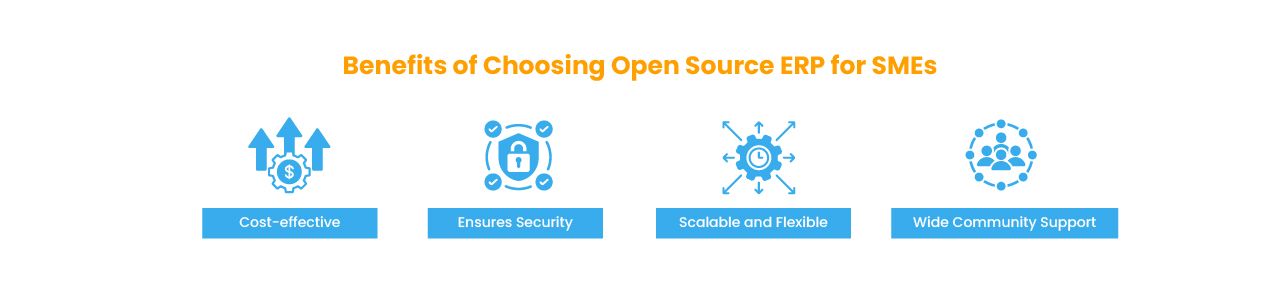
- Cost-effective implementation
- Improved security transparency
- Scalable and flexible architecture
- Strong community support
Potential Licensing Savings
Open-source ERP may reduce software licensing expenses, but it does not guarantee a lower initial project cost. Compare the full cost of configuration, data migration, integrations, hosting, training, upgrades, and support before choosing a system.
Improved Security Transparency
Security is a major concern for every business. With open-source ERP systems, developers and community contributors can review the source code, identify vulnerabilities, and release improvements more quickly. This transparency helps businesses strengthen security when the system is properly maintained and supported.
Scalable and Flexible Architecture
Open-source ERP systems often use a modular architecture, allowing SMEs to start with essential features and add more modules as their business grows. This flexibility helps businesses customize workflows, manage higher transaction volumes, and adapt the system to changing operational needs.
Strong Community Support
The open-source ecosystem is supported by global communities of developers, contributors, and technology experts. SMEs can benefit from documentation, forums, updates, and expert services that help improve the software and resolve technical challenges over time.
Which ERP Approach Fits Your Small Business?
Standard Processes and Limited Technical Capacity
Start by testing packaged applications against your essential accounting, purchasing, sales, and inventory workflows. Favor configuration over custom code, and confirm who will handle hosting, backups, updates, and support.
A Few Specialized Requirements
Check whether maintained extensions or integrations can close the gaps. Request a separate estimate for each customization, including its testing and maintenance requirements.
Complex Operations and a Development Budget
A framework-based application may be worth evaluating when specialized workflows cannot be supported effectively by existing products. Compare the development effort with the operational value, and assign long-term technical ownership before committing.
Company size alone should not determine the platform. A small business with complex fulfillment requirements may need more specialized software than a larger business with straightforward processes.
Key Considerations Before Adopting Open-Source ERP
While open-source ERP systems offer several benefits for SMEs, businesses should evaluate a few important factors before implementation. Proper planning helps ensure a smoother transition, better system performance, and long-term scalability.
- Data Migration: Moving data from an existing system to an open-source ERP solution requires careful planning. Businesses should choose a solution that supports secure and efficient data migration to reduce errors and downtime.
- User Training: Switching to a new ERP system can be challenging for employees. Proper training helps teams understand the platform, use key features effectively, and improve overall productivity.
- Customization Planning: SMEs should define their business requirements before customizing the ERP system. Clear planning helps avoid unnecessary complexity, delays, performance issues, and extra development costs.
- Data Security: Businesses should implement strong security measures such as encryption, access controls, regular updates, and user permission management to protect sensitive business data.
- Technical Expertise: Implementing and maintaining an open-source ERP system requires technical knowledge. Working with experienced developers or ERP consultants can help businesses deploy, customize, and manage the system successfully.
Choosing an ERP Your Team Can Maintain
Open-source ERP can suit a small business when its functionality, customization options, and support arrangements match the operational need. It may add unnecessary complexity when simpler software already handles the work effectively.
Before committing, test your essential workflows, estimate the full ownership cost, and confirm who will maintain the system after launch.
NOI Technologies provides ERP consulting to help businesses assess requirements, integrations, customization needs, and implementation scope.