Apache OFBiz Development & Consulting Services
Build, customize, integrate, upgrade, and support ERP and ecommerce systems with experienced Apache OFBiz developers and consultants.












What Do Apache OFBiz Development and Consulting Services Include?
Our Apache OFBiz development and consulting services cover technical assessment, implementation planning, custom development, integrations, data migration, version upgrades, and ongoing support. We review your requirements to identify where standard OFBiz functionality fits and where custom work is needed.
You can engage NOI Technologies for a specific project, dedicated development support, or training for your technical and business teams.
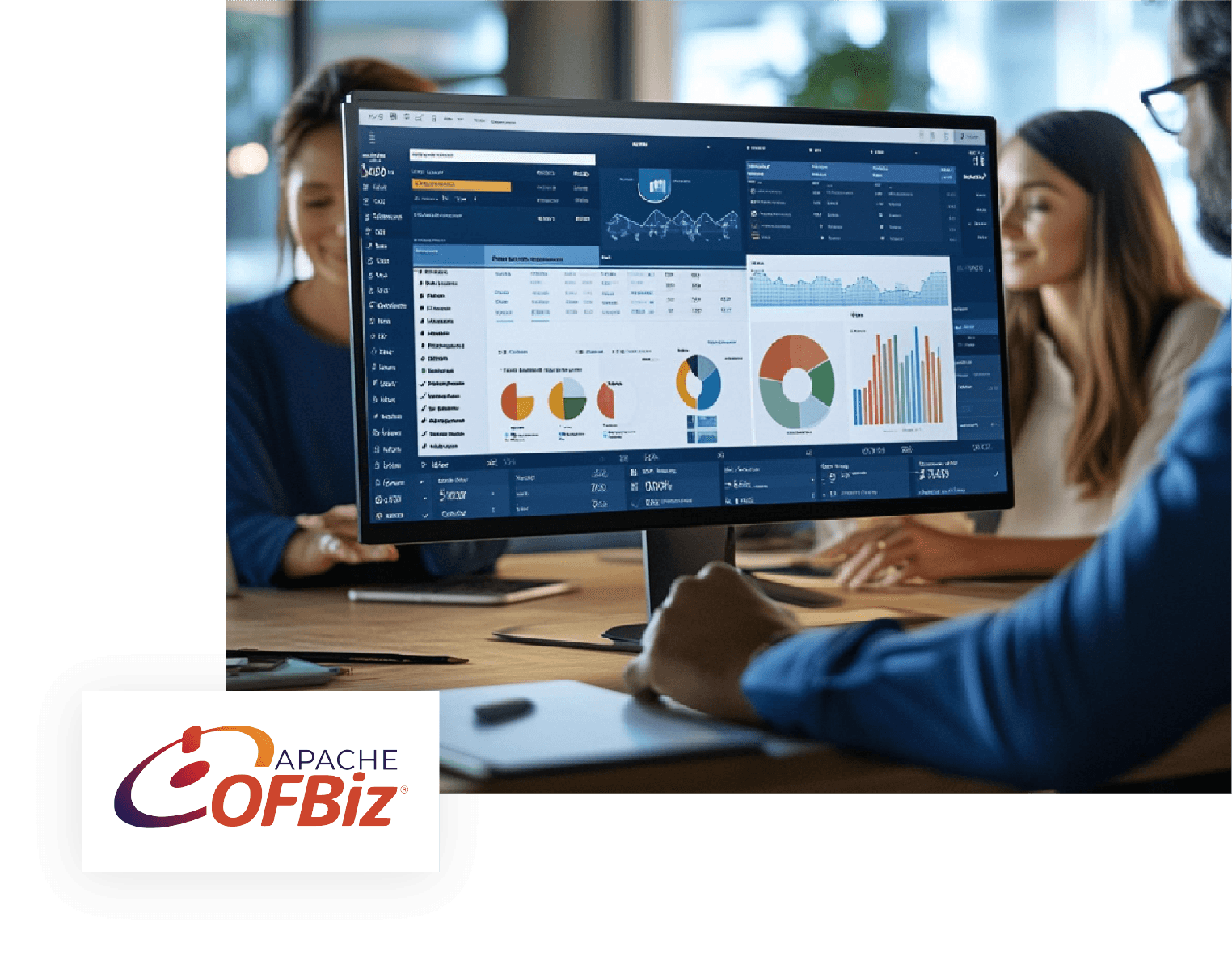
Our Apache OFBiz Development and Consulting Capabilities
Custom Apache OFBiz Development Services
We customize Apache OFBiz when standard functionality does not match your business requirements. This can include extending the data model, adding business rules, or creating screens that help your team complete daily tasks with fewer manual steps.
Development work can include:
- Custom components for business-specific requirements
- Entity Engine extensions for additional data fields and relationships
- Service Engine logic for validations and business rules
- Approval workflows based on user roles and defined conditions
- Custom screens, reports, and user interfaces
For a deeper look at customization approaches, see our OFBiz customization guide.

Apache OFBiz Consulting
Apache OFBiz consulting services help businesses make better technical decisions before and during implementation. This can include architecture planning, workflow mapping, module customization, integration planning, performance review, and guidance for internal development teams.

Hire Dedicated Apache OFBiz Developers
NOI provides dedicated OFBiz developers for companies that need ongoing customization, integration, maintenance, upgrades, or specialist support.
- Feature backlogs and enhancement requests
- Custom module development
- Third-party integrations
- Bug fixing and troubleshooting
- Version upgrades
- Testing and quality assurance
- Ongoing maintenance
- Augmenting internal engineering teams
Technical teams evaluating candidates can also review our OFBiz developer evaluation guide.

Apache OFBiz Integration Services
Apache OFBiz can be connected to the systems your business already runs on. Our integration work is planned around data mapping, API integration, and synchronization across your existing workflows.
- Payment gateways
- Ecommerce platforms
- Shipping systems
- CRM
- Warehouse Management Systems (WMS)
- Accounting software
- Custom APIs

Apache OFBiz Migration & Version Upgrades
Migrating to Apache OFBiz or upgrading an existing OFBiz system requires careful planning across data, modules, integrations, users, and business continuity. The process can involve moving from a legacy ERP, a homegrown system, another open-source platform, or an older OFBiz release. For existing environments, see our Apache OFBiz 18.12 to 24.09 upgrade guide.
Our migration process is structured to reduce downtime, protect business data, and avoid common pitfalls when moving to a new ERP platform. Each project starts with a system assessment and ends with stabilization support to ensure the new OFBiz environment is production-ready before the team fully transitions.
OFBiz Support & Performance Optimization
If your Apache OFBiz system is slow, timing out, showing high CPU usage, or becoming expensive to run, a technical health check can help identify the root cause before these issues affect order processing, reporting, integrations, and daily operations. Performance problems often come from database queries, server configuration, custom modules, integrations, caching, code quality, or workflow design.
Our team reviews the OFBiz system architecture, server setup, database performance, custom code, logs, integrations, and module behavior to find bottlenecks, stability risks, and scalability issues. Beyond performance tuning, we also provide ongoing support and maintenance, including troubleshooting, bug fixes, and security updates for existing Apache OFBiz implementations.

Apache OFBiz Training
Apache OFBiz training helps developers, administrators, and business users work confidently with the platform after implementation, customization, or migration. Training can be delivered remotely or on-site, depending on your team structure, project stage, and level of OFBiz experience.
Developer and administrator training can cover OFBiz framework fundamentals, Entity Engine, Service Engine, widgets, custom development, integrations, deployment, and troubleshooting. Business-user training can focus on daily workflows, reporting, process management, data accuracy, and system usage.

Our Approach
How We Approach Apache OFBiz Development and Consulting
Assess the Existing Environment
We review business workflows, the OFBiz release, custom components, data structures, integrations, deployment setup, and technical constraints before defining the scope.
Define the Technical Approach
We determine what can use standard OFBiz functionality, what requires configuration, and where custom components, services, entities, integrations, or architectural changes are appropriate.
Develop and Validate
Development is handled in controlled iterations with code review, workflow testing, integration testing, and validation against the affected business processes.
Deploy and Stabilize
Approved changes move into production with deployment planning, documentation, monitoring, and post-release support based on the needs of the environment.
Why Choose NOI Technologies for Apache OFBiz Development?
Apache OFBiz Service Provider Listing
NOI Technologies LLC is included in the Apache OFBiz Project's community-maintained Service Providers directory for companies offering OFBiz-related services.
Production OFBiz Project Experience
Our work includes the MPSTYLE implementation, connecting production planning, inventory, procurement, and finance through Apache OFBiz and custom modules.
Experience With Existing OFBiz Systems
We work with customized OFBiz environments, legacy code, and older versions, assessing existing workflows and dependencies before planning changes.
For Vinci School, a US-based education organization, NOI Technologies took over an existing Apache OFBiz platform and developed new features around the school's requirements. The team also investigated production issues, maintained workflows and integrations, and improved technical documentation as part of its maintenance and support work. Explore the Vinci School Apache OFBiz case study.
Apache OFBiz Case Study: MPSTYLE in Production
MPSTYLE needed to scale manufacturing operations while preserving important existing systems and workflows.
NOI Technologies used Apache OFBiz and custom modules to connect production planning, inventory, procurement, and finance workflows in a shared enterprise environment, with AI-supported forecasting incorporated into the planning process.
The implementation gave teams better coordination across planning, material availability, purchasing, production activity, and related financial processes.
Apache OFBiz ERP Solutions by Industry
| Use Case | Typical OFBiz Development Work | NOI Relevance |
|---|---|---|
| Ecommerce | Catalogs, pricing, orders, inventory, fulfillment, storefront integrations | Dedicated Apache OFBiz ecommerce development experience |
| Logistics & Supply Chain | Inventory, procurement, warehouse, shipment, and billing workflows | Warehouse and supply chain customization experience |
| Manufacturing | BOM, MRP, production planning, procurement, inventory, and costing | MPSTYLE production implementation |
| Education | Administration, billing, user management, reporting, and institutional workflows | Apache OFBiz feature development, maintenance, and support for Vinci School |




Discuss Your Apache OFBiz Project
Tell us about your current Apache OFBiz environment, custom development requirements, integration needs, upgrade plans, or support priorities.