
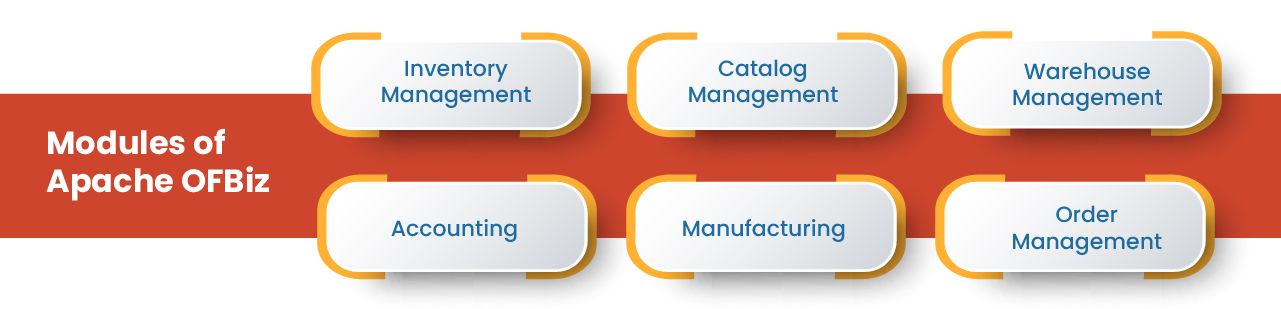
Apache OFBiz includes connected business applications for accounting, inventory, order management, ecommerce, manufacturing, warehousing, customer management, procurement, and human resources. Organizations can use these capabilities together, configure them around existing processes, or extend them through custom components.
This guide explains the major Apache OFBiz modules, the functions they support, and how they exchange data across business operations. If you are new to the platform, start with our Apache OFBiz overview for a broader introduction to the ERP system and framework.
Apache OFBiz Business Applications and Functional Areas
The sections below describe functional areas rather than a one-to-one list of installed applications. Availability depends on the OFBiz release and installed components. Some capabilities, including the ecommerce application, are provided through the complementary OFBiz plugins repository.
Accounting and Financial Management
The accounting module in Apache OFBiz helps businesses manage financial activities and connect accounting data with other operational processes.
It can support functions such as:
- Accounts receivable and accounts payable
- Invoices and billing
- Payments and statements
- Standard double-entry general ledger
- Budgeting and credit management
- Asset management and depreciation
- Financial reporting, with project-specific analytics added where required
Because accounting connects with orders, products, customers, suppliers, payments, and inventory, Apache OFBiz can help reduce duplicate financial data and improve consistency across business records.
Customization may be required when an organization has industry-specific accounting rules, approval processes, tax requirements, reporting formats, or integrations with external financial systems.
Product and Catalog Management
The catalog management module helps businesses organize product information inside the ERP system. This is especially useful for ecommerce, retail, distribution, and product-based businesses.
It can support:
- Multiple stores and product catalogs
- Product categories and subcategories
- Product variants based on attributes such as size, color, or type
- Promotions, coupons, and gift cards
- Customer-specific or group-based pricing rules
- Digital product assets such as images, videos, and documents
A structured catalog helps businesses manage product data more consistently across sales, inventory, order management, pricing, and ecommerce workflows.
Businesses with advanced product structures can review our detailed guide to Apache OFBiz catalog management.
Inventory Management
The inventory management module helps businesses track stock levels, product movement, facilities, warehouse locations, and inventory valuation.
It can support:
- Inventory management across multiple warehouses or facilities
- Batch, lot, and serial number tracking
- Current inventory visibility across configured facilities and locations
- Inventory reservations and availability
- Picklist and package management
- Stock transfers and adjustments
- Inventory valuation and reporting
Inventory data connects with products, orders, shipments, purchasing, manufacturing, and accounting. This allows businesses to coordinate stock activity with related operational and financial processes.
For businesses with complex inventory needs, Apache OFBiz can be customized to support specific replenishment rules, storage logic, barcode workflows, warehouse processes, and reporting requirements.
Manufacturing
The manufacturing module helps businesses manage production-related processes, from raw material planning to finished goods.
It can support:
- Bills of materials
- Production planning
- Material requirements planning
- Job shop workflows and routing
- Task and work-effort assignment
- Production costing and job costing
- Raw material procurement
- Inventory consumption and finished-goods tracking
Manufacturing processes can connect with inventory, procurement, orders, facilities, costing, and accounting. This helps teams coordinate material requirements, production activity, and product availability within one system.
Custom development may be required for specialized production stages, quality checks, industry-specific costing, shop-floor interfaces, or advanced planning requirements.
Organizations evaluating this use case can read our guide to Apache OFBiz for manufacturing ERP.
Order Management
The order management module helps businesses manage the order lifecycle from quotation and order creation to fulfillment, returns, refunds, and reporting.
It can support:
- Sales orders and purchase orders
- Quotes and order entry
- Order status and lifecycle management
- Inventory reservation
- Fulfillment coordination
- Returns and cancellations
- Refund processing
- Order reporting
Order management connects with product catalogs, pricing, customers, inventory, shipments, payments, invoices, and accounting records.
Customization may be required for company-specific approval flows, order types, pricing rules, fulfillment logic, subscriptions, or industry-specific transaction processes.
Warehouse and Fulfillment Capabilities
Apache OFBiz supports warehouse and fulfillment processes through connected inventory, facility, order, shipment, and package-management functions.
Warehouse-related capabilities may include:
- Inventory tracking across warehouse locations
- Receiving and stock movement
- Picking, packing, and shipping workflows
- Package and shipment management
- Inventory transfers between facilities
- Returns and reverse-logistics processes
- Warehouse reporting and operational visibility
For businesses that need ERP and warehouse processes connected, Apache OFBiz can provide a flexible foundation for custom fulfillment workflows.
Barcode scanning, mobile warehouse interfaces, storage-location rules, carrier integrations, and advanced allocation processes may require configuration, integration, or custom development.
For more detail, read our dedicated guide on using Apache OFBiz for warehouse management.
Customer Relationship Management
Apache OFBiz can support customer relationship management through shared party, contact, communication, marketing, sales, and service information.
CRM-related capabilities may include:
- Customer and organization records
- Contact information and communication history
- Leads and sales opportunities
- Sales forecasting
- Marketing lists and campaigns
- Customer service requests
- Customer-specific pricing and account information
Customer data can connect with quotations, orders, invoices, payments, marketing activities, service requests, and ecommerce accounts.
Businesses may need custom development when they require specialized sales pipelines, communication tools, automated follow-ups, external CRM integrations, or industry-specific customer workflows.
Ecommerce
Apache OFBiz includes ecommerce capabilities that can connect online shopping activity with product catalogs, pricing, customer accounts, inventory, orders, payments, and fulfillment.
It can support:
- Online stores and product catalogs
- Shopping carts and checkout workflows
- Customer accounts
- Pricing and promotions
- Order creation and payment processing
- Inventory availability
- Shipment and fulfillment coordination
OFBiz can be used with its standard ecommerce applications or as a backend system connected to a separate storefront. Integrations with external platforms may require custom APIs, data mapping, synchronization, and error handling.
For a deeper explanation, read our guide to Apache OFBiz features for ecommerce solutions.
Procurement
Procurement capabilities help organizations manage suppliers, purchase requirements, purchase orders, receiving, inventory updates, invoices, and supplier payments.
These functions may include:
- Supplier and vendor records
- Purchase orders
- Product and supplier associations
- Receiving and inventory updates
- Supplier invoices
- Payment and accounting coordination
Procurement connects closely with inventory, manufacturing, facilities, accounting, and order management.
Human Resources
Depending on the implementation scope and available applications, Apache OFBiz can support employee records, organizational structures, positions, skills, employment information, and related administrative processes.
Human resource requirements often vary considerably between organizations. Payroll, attendance, compliance, recruitment, performance management, or country-specific employment processes may require custom components or integration with specialized HR systems.
Project and Work Management
Apache OFBiz can support projects, tasks, work efforts, assignments, schedules, time tracking, and related business activities.
These capabilities may be useful for service organizations, internal projects, manufacturing tasks, maintenance activities, and operational planning.
How Apache OFBiz Modules Work Together
Apache OFBiz applications use shared data models and reusable business services, allowing information to move between related operational functions.
This means business processes do not have to operate as isolated modules. A transaction created in one area can update records, trigger services, or create follow-up activities in another area.
Order-to-Cash Workflow
A sales order can use customer, catalog, product, pricing, and promotion data. The system can then check inventory availability, reserve stock, create fulfillment activity, generate a shipment, produce an invoice, record payment information, and update the related accounting records.
The exact order-to-cash flow depends on the configured order types, payment methods, inventory rules, shipment processes, and accounting setup.
Procure-to-Pay Workflow
A purchase requirement can lead to supplier selection, purchase-order creation, receiving, inventory updates, supplier invoicing, payment processing, and accounting entries.
This connects procurement activity with products, suppliers, facilities, inventory, invoices, payments, and financial reporting.
Manufacturing Workflow
Production demand can affect material requirements, purchasing, inventory reservations, production routing, work activities, raw-material consumption, finished-goods inventory, costing, and order fulfillment.
The exact manufacturing workflow depends on bills of materials, routing, facility configuration, costing rules, inventory processes, and any custom production requirements.
Standard Apache OFBiz Capabilities vs Custom Development
Not every requirement needs custom code. Organizations should first review the standard applications and configuration options before deciding where development is necessary.
| Requirement | Likely Approach |
|---|---|
| Standard products, orders, invoices, payments, and inventory | Use and configure existing Apache OFBiz applications |
| Company-specific roles, statuses, and approval rules | Configure permissions and extend existing workflows where necessary |
| External marketplaces, carriers, payment systems, or storefronts | Build or configure integrations |
| Specialized manufacturing or warehouse processes | Evaluate existing functionality and configuration, then develop extensions for the remaining gaps |
| Industry-specific reports and dashboards | Develop custom data views, reports, or analytics integrations |
Custom development should address a clear business requirement. Unnecessary changes can increase implementation cost and make maintenance or future upgrades more difficult.
Plan the Right Apache OFBiz Module Mix
The right module mix depends on the organization’s processes, data, user roles, reporting requirements, transaction volume, and external systems. Standard applications should be reviewed before deciding where configuration, integration, or custom development is required.
Organizations planning a larger implementation can read our Apache OFBiz implementation guide.
Our Apache OFBiz development, integration, and consulting services can help you assess available functionality, identify gaps, and plan the necessary integrations or extensions.