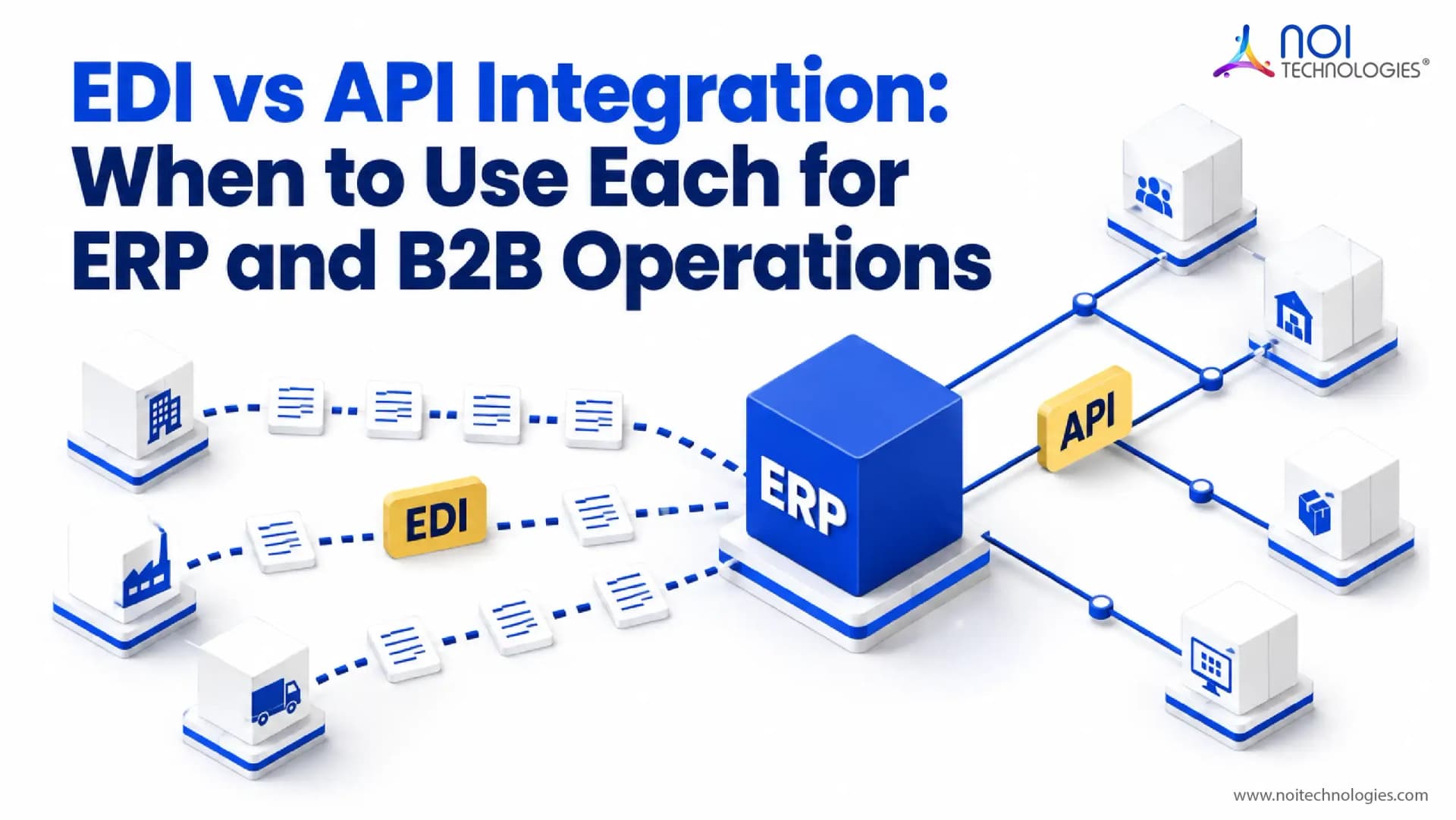
EDI exchanges structured business documents between trading partners, while an API lets applications request data or perform actions through a defined interface. Use the method required by the transaction and the connected systems. Many ERP environments use both: EDI for retailer purchase orders and invoices, and APIs for ecommerce, warehouse, and customer-facing applications.
Companies connecting ERP systems with retailers, suppliers, warehouses, ecommerce platforms, logistics providers, and other business applications rarely have just one type of integration to manage. An established retailer may exchange standardized EDI documents. At the same time, an ecommerce storefront, warehouse system, or customer portal connects through an API.
Both integration methods can support the same business operation, but they solve different problems. Electronic Data Interchange, or EDI, is built around structured business documents exchanged between organizations. APIs provide defined interfaces through which software applications can request data, submit transactions, or invoke functions in another system.
The retailer may use an EDI transaction that follows an agreed trading-partner specification. The storefront may call an API because it needs an immediate inventory response. Both transactions can eventually create or update records in the same ERP environment.
EDI vs API Integration: What Is the Difference?
EDI and APIs both move information between systems, but they approach integration differently. EDI is primarily designed for standardized business-document exchange between trading partners. APIs are typically used when one application needs data or functionality from another application.
A large retailer, for example, may send an X12 850 purchase order because that transaction is part of its established supplier process. A direct-to-consumer storefront may create an order through an API because it connects directly to the seller's application environment.
Both orders can eventually become sales orders in an ERP system, even though they entered through different integration paths.
| Area | EDI | API |
|---|---|---|
| Primary purpose | Standardized business-document exchange | Application-to-application interaction |
| Typical use | Purchase orders, invoices, shipment notices, inventory messages | Inventory queries, order creation, shipment status, pricing, application functions |
| Common standards or approaches | X12, EDIFACT | REST, GraphQL, SOAP |
| Typical payload | Structured EDI transactions | JSON, XML, or API-specific payloads |
| Typical relationship | Trading partner to trading partner | Application to application |
| Onboarding | Partner specification, mapping, transport setup, and testing | API contract, authentication, mapping, and testing |
| Real-time interaction | Possible depending on transport and processing design | Common for interactive or event-driven workflows |
| What it defines | The structure and meaning of standardized business documents | How applications request data or invoke operations through an interface |
When Should You Use EDI, API, or Both?
Start by asking who controls the connection. If a trading partner specifies an EDI transaction and implementation guide, the partner's requirements largely determine the exchange. If your team controls both applications and needs an inventory lookup or system action, an API may be a better fit. If both conditions apply across the business, plan for a hybrid architecture.
Many ERP environments need both. Retail partners may continue exchanging purchase orders, shipment notices, and invoices through EDI while ecommerce platforms, warehouse applications, portals, and internal systems use APIs around the same ERP.
| Requirement | EDI | API | Hybrid |
|---|---|---|---|
| Trading partner requires X12 transactions | Strong fit | Usually not sufficient by itself | Strong fit |
| Standard purchase-order and invoice exchange | Strong fit | Possible when both parties support it | Useful in mixed environments |
| Current inventory query from a storefront | Usually unnecessary | Strong fit | Strong fit when EDI partners share the same backend |
| Customer or employee application | Poor fit for direct interaction | Strong fit | Useful in mixed enterprise environments |
| Existing network of EDI trading partners | Strong fit | Replacement requires partner agreement and testing | Often practical |
| ERP, ecommerce, WMS, and retail partners in one environment | Useful for partner documents | Useful for application connections | Strong fit |
What Is EDI Integration?
EDI integration connects business systems so structured commercial documents can move between trading partners without repeated manual entry.
Suppose a retailer creates a purchase order in its procurement system. Instead of emailing a PDF that someone at the supplier must re-enter into an ERP, the retailer can transmit an EDI purchase order. The receiving environment identifies the trading partner, validates the transaction, applies the required mapping rules, and converts the information into a form the ERP can process.
In North America, ANSI X12 transaction sets are widely used for this type of exchange. The X12 transaction set directory defines transactions for different business purposes.
| X12 Transaction | Business Purpose |
|---|---|
| 850 | Purchase Order |
| 855 | Purchase Order Acknowledgment |
| 856 | Ship Notice / Manifest |
| 810 | Invoice |
| 846 | Inventory Inquiry / Advice |
| 997 | Functional Acknowledgment |
The transaction format is only one part of an EDI connection. Trading partners also need an agreed method for transmitting documents. Common approaches include AS2, SFTP, and value-added networks.
Transport and document structure solve different problems. AS2 can securely transport an EDI document over the internet, for example, but it does not decide how a retailer's product number, location code, or requested quantity should be represented inside the supplier's ERP.
What Is API Integration?
API integration allows one software application to interact with another through a defined interface. Instead of exchanging a standardized commercial document, the connected application can request information or invoke a specific function exposed by another system.
An ecommerce storefront checking available inventory is a straightforward example. It may submit a SKU and location to an inventory service and receive the available quantity before the customer completes an order. A warehouse application might use another API to receive fulfillment work or return shipment information.
The API contract defines what data can be requested or submitted, how the request is authenticated, and how the receiving application responds.
For systems that require real-time data exchange and flexible application connectivity, API-first ERP integration can provide a more adaptable integration approach.
EDI Is Not Inherently Batch-Based
EDI is often described as batch-based while APIs are described as real time. That comparison may describe a particular implementation, but it is not a reliable architecture rule.
EDI documents can be transmitted quickly using methods such as AS2. What happens next depends on how the receiving environment validates, maps, queues, and processes the document.
APIs are not inherently synchronous either. An application can submit a request that is placed in a queue for later processing, and scheduled jobs can call an API periodically instead of continuously.
Processing speed should therefore come from the business requirement. An inventory check during checkout may need an immediate response. An invoice or inventory advice message may operate on a different processing schedule without creating an operational problem.
How Do EDI and APIs Work Together in ERP Architecture?
In a hybrid EDI and API integration architecture, external trading-partner requirements can remain separate from the interfaces used by internal and customer-facing applications.
A wholesaler might receive orders from major retail customers through EDI while accepting ecommerce orders through an API. Both can be normalized into the same ERP sales-order model before allocation and fulfillment begin.
Our custom order management system guide explains how inventory allocation, order routing, and fulfillment exceptions work after an order enters the system.
The ERP may then send fulfillment work to a WMS through an API. Once the warehouse picks and ships the order, shipment information returns to the ERP. If the originating customer requires EDI, those ERP shipment records can be used to generate the corresponding outbound transaction.
| Business Event | Integration Method | Example Flow |
|---|---|---|
| Retailer submits wholesale order | EDI 850 | Retailer → EDI layer → ERP |
| Ecommerce customer places order | API | Storefront → ERP |
| Order released for fulfillment | API | ERP → WMS |
| Warehouse confirms shipment | API or event | WMS → ERP |
| Retailer receives shipment information | EDI 856 | ERP → EDI layer → Retailer |
| Retailer receives invoice | EDI 810 | ERP → EDI layer → Retailer |
API Applications With an EDI Trading-Partner Backend

The direction can also be reversed. A customer portal or another application may create a transaction through an API, while the resulting business document must later be sent through EDI to a manufacturer, distributor, retailer, or logistics partner.
The application does not need to implement every partner-specific EDI requirement itself. The integration layer can transform normalized business data into the document and mapping expected by the receiving partner.
Modernizing Around an Existing EDI Gateway
A company can also introduce APIs without rebuilding stable EDI connections. Consider a distributor that already exchanges orders, shipment notices, and invoices with dozens of retail customers through EDI. If the distributor introduces a new WMS and customer portal, those applications can use APIs while the retailer connections continue operating as before.
The portal can retrieve ERP order or shipment status through an API. The WMS can receive fulfillment work and return shipment confirmations through APIs. EDI remains at the trading-partner boundary where it is already established.
This incremental approach to EDI modernization allows internal systems to change without forcing every external partner to migrate at the same time.
ERP integrations often need to connect both warehouse operations and customer-facing sales channels. Our ERP and WMS integration guide explains how warehouse systems exchange inventory, order, and fulfillment data, while the ERP ecommerce integration guide covers synchronization with online stores and marketplaces.
How Does an EDI Purchase Order Move Through an ERP?
An incoming EDI purchase order requires more than converting one file format into another. The data has to move from an external trading-partner structure into records and values the ERP understands.
When an X12 850 arrives, the receiving environment first identifies the trading partner and validates the transaction. The partner's mapping rules are then applied before the order is passed into the ERP.
This mapping matters because two retailers can both send an X12 850 without using it in exactly the same way. Each partner may have its own implementation guide, identifiers, qualifiers, required fields, and code values.
One retailer may send its own item numbers while the supplier's ERP operates on internal SKUs. Another may identify products using UPC values. Ship-to locations may need to be cross-referenced to customer or facility records. Units of measure, requested dates, terms, and other values also need to match the ERP's internal business model.
Handling those differences before the transaction enters core order logic allows the ERP to work with a normalized sales order instead of carrying retailer-specific rules throughout the application.
Once the order is created, normal operational processing can begin. The ERP may validate the customer, check product data, evaluate inventory, apply allocation rules, and determine the fulfillment location.
If fulfillment runs in a separate warehouse system, the ERP can release the order to the WMS through an API. When the warehouse confirms shipment, the ERP updates the corresponding order and shipment records.
Those records can then become the source for an outbound 856 shipment notice and, when appropriate, an 810 invoice.
Keeping partner-specific EDI mapping separate from the internal business model also limits the impact of future changes. If one retailer changes an identifier or implementation rule, its mapping can be updated without redesigning every unrelated ERP integration.
Why Are Technical Acknowledgment and Business Acceptance Different?
An EDI document can be delivered successfully without the underlying business transaction being accepted.
For example, an AS2 Message Disposition Notification can confirm that a message reached the receiving AS2 environment. An X12 997 Functional Acknowledgment can communicate the result of syntactical validation of the received transaction.
Neither response necessarily means the underlying purchase order has been commercially accepted.
An 855 Purchase Order Acknowledgment serves a different purpose. Depending on the trading relationship, it can communicate the seller's response to the buyer's purchase order.
This distinction matters in operational monitoring. Message delivery, document validation, ERP processing, and business acceptance are separate stages. Treating them as one status can leave teams believing a transaction succeeded even though it never became a valid business record.
What Must Be Defined for Each EDI Trading Partner?
Supporting an X12 transaction does not automatically make an organization ready to exchange that transaction with every partner that uses it.
Two retailers may both send an 850 purchase order while expecting different identifiers, qualifiers, fields, code values, versions, and operating rules. The transaction standard defines the document structure, while the trading partner's implementation requirements determine how that structure is used in the relationship.
Before onboarding a partner, the implementation team may need to define the trading-partner identifier, supported transaction sets, version or implementation guide, required fields, transport method, and environment configuration.
Business identifiers often require their own cross-references. Product numbers, customer accounts, facility codes, units of measure, carrier codes, and other values may not match the identifiers used internally by the ERP.
Acknowledgment expectations must also be clear. The team needs to understand which transmission or functional acknowledgments are required and which business responses the partner expects after the transaction enters the application.
Testing requirements can vary as well. Some trading relationships involve certification steps, sample transactions, separate test credentials, or validation against a partner's implementation guide before production documents can be exchanged.
Exception handling needs to be designed before go-live. If a partner sends an unknown item number or an unrecognized ship-to location, creating a partially mapped ERP order may be worse than holding the transaction for review. The team needs to know who owns that exception and how the transaction will be corrected and reprocessed.
ERP integration requirements should be documented alongside broader system needs, including ownership, data exchange frequency, business rules, and exception handling. Our ERP requirements checklist can help teams capture these requirements during ERP planning.
What Problems Commonly Affect EDI and API Integration?
Successful transmission does not guarantee a successful business transaction. An API request may reach the ERP but fail because the SKU cannot be matched. An EDI document may pass structural validation while containing a facility code that has no corresponding ERP record.
Retries create another concern. If the receiving system does not recognize that a transaction was already processed, retrying a failed request or resending a document can create duplicate orders, shipments, or financial records.
Field meaning can also create subtle errors. A quantity might refer to ordered, allocated, picked, shipped, canceled, or available inventory depending on the source system. Mapping fields by similar names without preserving their business meaning can produce technically valid but operationally incorrect data.
Exceptions also need a clear owner. If an EDI document contains an unmapped item or an API-submitted order fails ERP validation, someone needs a defined process for reviewing the error, correcting the underlying issue, and determining whether the transaction should be processed again.
As ERP integrations expand, teams need clear processes for handling failed transactions, data mismatches, and reconciliation between connected systems. These issues are covered in more detail in our ERP integration challenges guide.
How Can EDI and API Integration Work With Apache OFBiz and Moqui?
Apache OFBiz and Moqui can serve as the enterprise application layer in environments where trading partners use EDI while other systems connect through APIs.
With Apache OFBiz, an EDI platform or integration layer can receive a partner document, apply partner-specific translation and mapping, and then invoke OFBiz services or create the appropriate business records using normalized data. Shipment and invoice information generated later in the ERP can move through the same integration layer for outbound EDI processing.
Moqui follows a service-oriented application model as well. A Moqui-based application can process normalized information received through an EDI layer while exposing application services for integrations that use APIs or other remote interfaces.
The important architectural boundary is the same in either case: retailer-specific or supplier-specific EDI rules should not unnecessarily spread through core enterprise logic. The integration layer handles external document requirements while the ERP works with consistent orders, products, customers, inventory, shipments, and financial records.
For help connecting your enterprise systems, explore our Apache OFBiz integration services and Moqui integration services.
Planning EDI and API Integration Around ERP Workflows
The integration method should follow the transaction and the systems involved. A long-standing retail relationship may continue using EDI, while a WMS, ecommerce storefront, or customer application connects to the same ERP through APIs. What matters is that each integration preserves the business meaning of the transaction and produces consistent records inside the enterprise system.
NOI Technologies works with Apache OFBiz, Moqui Framework, custom ERP applications, warehouse workflows, ecommerce systems, and connected enterprise applications. For custom ERP projects, EDI and API requirements can be evaluated alongside the order, inventory, fulfillment, integration, and financial processes they need to support.
Planning a custom ERP with EDI, API, ecommerce, warehouse, or trading-partner requirements? Let's talk through your workflows and integration needs. Discuss your ERP requirements with NOI Technologies.