Enterprise resource planning software can improve how a business manages finance, inventory, purchasing, manufacturing, reporting, and other connected operations. However, these improvements must be compared with the full cost of selecting, implementing, maintaining, and supporting the system.
Calculating ERP return on investment helps businesses determine whether an implementation is producing measurable financial and operational value. It also provides a practical way to evaluate performance after go-live instead of treating implementation as the end of the project.
This guide explains how to calculate ERP ROI, estimate the payback period, identify measurable benefits, and improve returns throughout the system lifecycle.
What Is ERP ROI?
ERP ROI measures the financial value generated by an ERP system relative to its total cost. The calculation may include cost savings, productivity improvements, reduced inventory expenses, lower error rates, and additional revenue that can reasonably be attributed to the implementation.
A clear ROI assessment can help an organization:
- Build a financial case for an ERP implementation.
- Establish measurable goals before the project begins.
- Compare actual results with the expected business case.
- Identify processes that require further optimization.
- Support decisions about upgrades, integrations, and additional modules.
ROI should not be treated as a one-time estimate created only for project approval. It should be reviewed after implementation using actual costs and operational data.
How to Calculate ERP ROI
Before calculating ROI, define the evaluation period and record the organization’s current performance. This baseline may include processing time, labor costs, inventory levels, error rates, order cycle times, and other metrics related to the processes the ERP system will affect.
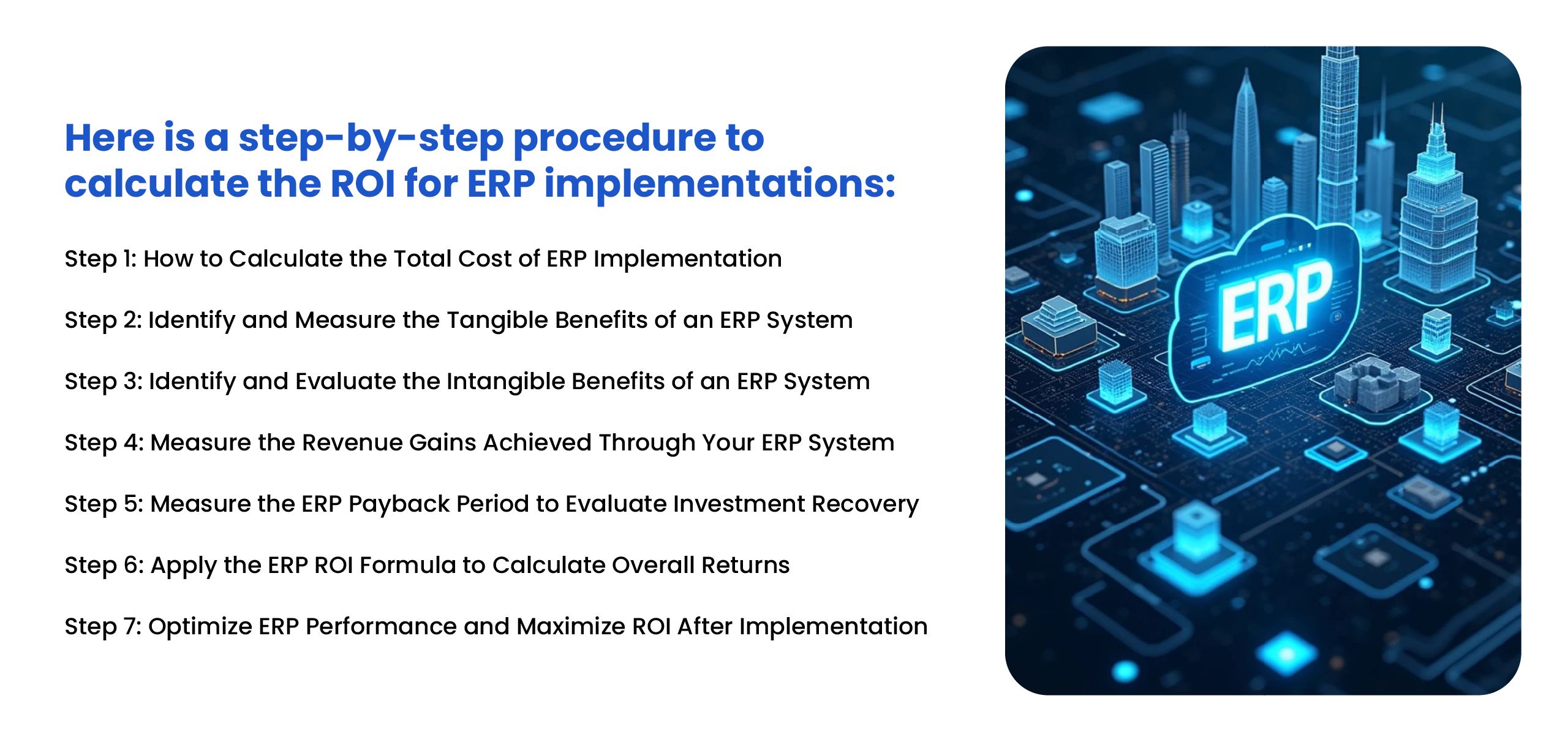
1. Define the Measurement Period and Baseline
Select a consistent period for evaluating ERP performance, such as three or five years. A longer period may provide a more complete view because implementation costs are often concentrated at the beginning, while benefits accumulate over time.
Document current performance before implementation. Without a baseline, it becomes difficult to determine whether improvements came from the ERP system or from unrelated business changes.
2. Calculate the Total Cost of ERP Implementation
ERP investment includes more than the purchase price or subscription fee. Include both initial and ongoing expenses in the calculation.
- Software costs: Licensing fees, cloud subscriptions, modules, user licenses, and related software expenses.
- Implementation costs: Planning, configuration, customization, testing, data migration, and project management.
- Integration costs: Connections with ecommerce platforms, financial applications, warehouse systems, customer portals, and other business tools.
- Infrastructure costs: Hosting, hardware, networking, security, backups, and technical resources.
- Training and change management: User training, documentation, workshops, internal communication, and process transition activities.
- Ongoing costs: Maintenance, support, upgrades, additional development, system administration, and future scaling requirements.
A detailed cost assessment makes the ROI calculation more reliable and reduces the risk of overlooking expenses that appear after deployment. An experienced ERP consultant can also help identify technical and operational costs during the planning stage.
3. Measure Tangible ERP Benefits
Tangible benefits can be assigned a financial value and included directly in the ROI calculation. The relevant benefits will depend on the processes included in the implementation.
- Reduced labor costs: Automation may decrease the time employees spend on repetitive data entry, reconciliation, reporting, and approvals.
- Lower error and rework costs: Centralized information and standardized workflows may reduce duplicate records, incorrect transactions, and manual corrections.
- Lower inventory costs: Improved visibility can help reduce excess stock, shortages, emergency purchases, and avoidable storage expenses.
- Faster operational cycles: Shorter order-to-cash, procure-to-pay, production, or reporting cycles may improve cash flow and resource utilization.
- Reduced software costs: Consolidating disconnected applications may reduce licensing, maintenance, integration, and administration expenses.
- Additional revenue: Better capacity, order accuracy, customer service, or product availability may contribute to revenue growth.
Only include revenue gains that can be reasonably connected to the ERP implementation. General business growth should not automatically be counted as an ERP benefit.
4. Track Non-Financial Benefits Separately
Some ERP benefits are valuable but difficult to convert into a reliable financial amount. These should be monitored alongside ROI rather than assigned an arbitrary value.
Examples include improved employee experience, stronger reporting controls, better collaboration between departments, more consistent customer service, and improved regulatory documentation.
These outcomes may eventually influence costs or revenue, but they should only be added to the financial calculation when the organization can support the value with measurable data.
5. Calculate the ERP Payback Period
The payback period estimates how long it will take for the financial benefits generated by the ERP system to recover the original investment.
Payback Period = Total ERP Investment ÷ Annual Net Benefit
For example, if an ERP implementation costs ₹200,000 and produces ₹100,000 in annual net benefits, the estimated payback period is two years.
A shorter payback period may indicate a more attractive investment, but it should not be evaluated alone. The organization should also consider the system’s long-term operating costs, scalability, security, and ability to support future requirements.
6. Apply the ERP ROI Formula
Once the costs and measurable financial benefits have been calculated, use the following formula:
ERP ROI (%) = [(Total Financial Benefits − Total ERP Costs) ÷ Total ERP Costs] × 100
ERP ROI Calculation Example
Assume an organization records the following figures over a five-year evaluation period:
- Total ERP costs: ₹350,000
- Annual net financial benefits: ₹120,000
- Total five-year benefits: ₹120,000 × 5 = ₹600,000
ROI = [(₹600,000 − ₹350,000) ÷ ₹350,000] × 100
ROI = 71.43%
In this example, the ERP system recovers the original investment and generates an additional ₹250,000 in net financial value over five years.
The result should be evaluated against the organization’s original targets, cost of capital, alternative investments, risk tolerance, and expected system lifespan. There is no universal ROI percentage that determines whether every ERP project is successful.
ERP Metrics to Monitor After Implementation
ERP performance should be measured using indicators connected to the original business case. Depending on the implementation, these may include:
- Order-to-cash cycle time
- Purchase order processing time
- Inventory turnover
- Inventory carrying costs
- Order accuracy
- Production cycle time
- Financial closing time
- Revenue per employee
- Manual transaction volume
- System adoption by department
Tracking too many unrelated metrics can make the assessment difficult to interpret. Prioritize the measurements that correspond directly with the original implementation goals.
How to Improve ERP ROI After Go-Live
The value of an ERP system depends on how effectively it is used after deployment. Businesses can improve long-term returns through several practical measures.
Review Workflows Regularly
Processes designed during implementation may become outdated as the business changes. Review workflows, approval paths, reports, and automation rules to identify delays or unnecessary manual steps.
Improve User Adoption
Low adoption reduces the value of the system. Provide role-specific training, maintain clear documentation, collect user feedback, and address usability problems that cause employees to rely on spreadsheets or disconnected tools.
Monitor Data Quality
Duplicate, incomplete, or inconsistent records can weaken reporting and automation. Establish data ownership, validation rules, naming standards, and regular data-quality reviews.
Remove Unused Features and Licenses
Review user accounts, modules, integrations, infrastructure, and support arrangements. Removing unnecessary licenses or services can lower recurring costs without affecting essential operations.
Prioritize High-Value Improvements
Not every customization will produce a meaningful return. Focus development resources on changes that reduce operating costs, improve control, remove bottlenecks, or support measurable growth.
How NOI Technologies Supports ERP ROI Planning
A successful ERP project begins with a clear understanding of business processes, system requirements, integration needs, data dependencies, and expected outcomes.
NOI Technologies provides ERP consulting, implementation, integration, customization, and post-deployment support. Our team can help businesses assess requirements, estimate implementation costs, define measurable performance indicators, and develop custom ERP solutions based on their operational needs.
Businesses evaluating different implementation approaches can also review the differences between custom ERP development and off-the-shelf ERP software before selecting a system.
Plan an ERP Implementation Around Measurable Results
Discuss your ERP requirements, implementation costs, integration needs, and performance goals with our team.