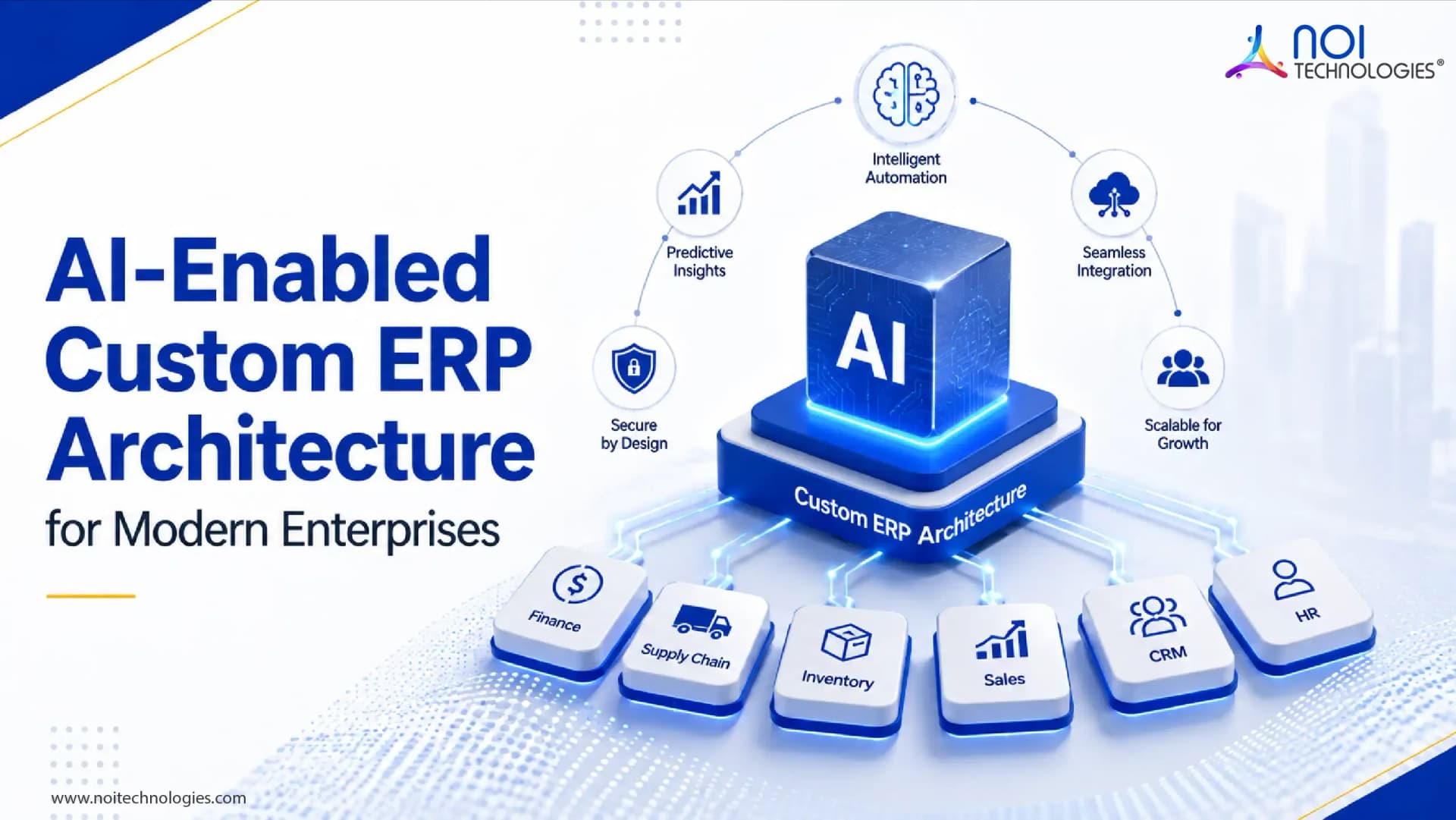
For decades, Enterprise Resource Planning systems functioned primarily as structured control environments. They centralized financial transactions, monitored inventory movement, and coordinated procurement, manufacturing, and reporting processes. That stability remains valuable, but traditional ERP systems were mostly designed to record what had already happened.
As retail volatility increases, supply chains become more fragmented, and manufacturing cycles compress, reactive ERP models are becoming harder to justify for modern enterprises.
For many enterprises, the problem is no longer whether ERP data exists. The problem is whether the system can use that data fast enough to support better planning, faster exception handling, and more accurate operational decisions.
By 2026, the discussion around custom ERP development has shifted from configuration to architecture. Modern enterprise systems are no longer designed solely to execute predefined workflows within traditional ERP implementation models. They are increasingly built to interpret operational data patterns and support forward-looking decisions across finance, supply chain, and operations.
This evolution does not mean ERP systems are being replaced. It means ERP architecture is being redesigned around data, automation, intelligence, and governance.
What AI-Enabled ERP Architecture Includes
An AI-enabled ERP connects business applications with models that generate forecasts, extract document fields, identify unusual activity, or recommend actions. Models can run in separate services, with the ERP controlling how their outputs enter business workflows.
For example, a procurement model can flag changes in supplier pricing or delivery performance. The ERP still applies purchasing permissions, budget checks, and approval rules before an order is placed.
For the business use cases and potential benefits, see our guide to how AI is transforming ERP.
A Reference Architecture for AI-Enabled ERP
The following design separates model processing from ERP transactions. It can be adapted for forecasting, document extraction, and workflow recommendations.
ERP Applications and Business Services
The ERP maintains authoritative business records and applies permissions, validation rules, approvals, and transaction controls. Approved AI recommendations enter the system through these services.
Data Preparation and Integration
An integration component retrieves the records needed for a specific task, checks their completeness, and prepares the model input. Each request should identify the relevant records and the time the data was captured.
Model Services
A separate service runs the selected model and returns a structured result. The integration records the model version and request identifier so the result can be traced and investigated.
Output Validation and Workflow Routing
Before a result affects operations, the application checks required fields, valid identifiers, business constraints, and whether the source data has changed. Results that fail these checks move to an exception queue.
User Review and Operational Monitoring
Users see the recommendation alongside the relevant ERP records. Monitoring tracks processing failures, response times, accepted recommendations, corrections, and business outcomes. Access controls and audit logging apply across every component.
Traditional ERP vs. AI-Driven ERP Systems

Legacy ERP environments typically:
- Operate through predefined rule-based workflows
- Focus on historical reporting
- Require manual interpretation of trends
- Separate analytics from transaction processing
AI-driven ERP platforms increasingly:
- Integrate predictive analytics directly into core modules
- Surface risk indicators in real time
- Support natural language data interaction through governed AI agents
- Continuously refine workflow logic based on operational feedback
| Area | Traditional ERP | AI-Enabled ERP |
|---|---|---|
| Planning | Based on historical reports and fixed rules | Uses predictive models and real-time data signals |
| Inventory | Relies on reorder points and manual review | Adjusts planning based on demand, lead time, and supplier trends |
| Finance | Identifies issues during review or reconciliation | Detects unusual transaction patterns earlier |
| Workflows | Runs predefined approval and task flows | Adapts recommendations based on context and risk |
This shift alters how enterprise systems contribute to strategy. ERP becomes a decision-support framework rather than a static control system.
For example, in a multi-warehouse retail or ecommerce fulfillment environment, an AI-enabled ERP system can identify a regional demand surge and reallocate stock across locations before a stockout impacts customer fulfillment.
Key Characteristics of AI-Enabled Custom ERP
AI-enabled custom ERP architecture typically includes:
- Embedded predictive analytics within core ERP modules
- Intelligent workflow automation based on contextual data
- Real-time anomaly detection across financial and operational data
- Governed AI agents for natural language interaction
- Structured data governance and model oversight
Common AI Use Cases in Custom ERP Systems
AI-enabled ERP architecture becomes more valuable when it is connected to specific business use cases. For modern enterprises, the most practical AI ERP use cases often appear in planning, finance, procurement, inventory, and operations.
- Demand forecasting: Predict future demand using sales history, seasonality, customer behavior, and market signals.
- Inventory optimization: Adjust replenishment planning based on stock movement, supplier delays, and warehouse-level demand.
- Financial anomaly detection: Identify unusual payments, reconciliation gaps, duplicate invoices, or suspicious transaction patterns.
- Procurement intelligence: Compare supplier performance, delivery reliability, pricing changes, and risk patterns.
- Production planning: Improve scheduling decisions based on material availability, order priority, capacity, and lead times.
- Workflow automation: Route approvals, exceptions, and tasks based on urgency, role, risk, and operational context.
How AI Impacts Retail, Supply Chain, and Manufacturing Operations
The most immediate impact of intelligent ERP architecture appears in financial management and supply chain operations.
In finance, machine learning models embedded within general ledger workflows can detect unusual payment patterns, highlight reconciliation inconsistencies, and forecast short-term liquidity constraints. Instead of accelerating month-end reporting alone, AI integration improves accuracy and reduces downstream risk.
Within supply chain and logistics management environments, AI-driven ERP systems evaluate SKU velocity, supplier performance metrics, logistics variability, and production cycles to optimize replenishment strategies. Rather than depending on fixed safety stock levels, inventory planning adjusts dynamically based on contextual data inputs.
These capabilities are particularly relevant in manufacturing and distribution environments where volatility directly affects margins.
Evaluating AI for Your ERP Architecture?
Integrating AI with Moqui and Apache OFBiz
Open-source frameworks such as Moqui Framework and Apache OFBiz can provide the enterprise application foundation for this design.
For either platform, define how the integration retrieves authorized data, calls model services, validates results, and submits approved changes through ERP business services.
For an OFBiz-specific explanation, see our guide to Apache OFBiz AI integration, including use cases, integration approaches, and implementation considerations.
Can AI Be Integrated into an Existing ERP?
AI can be added to an existing ERP when the system provides suitable access to data and business services. A separate model service can generate forecasts or recommendations, while the ERP validates approved changes through its existing workflows. The approach depends on available interfaces, data quality, access controls, and the limitations of the current system.
How to Build an AI-Enabled ERP Architecture
Building an AI-enabled ERP system requires more than adding predictive tools to existing workflows. The architecture needs to support clean data movement, secure model access, role-based decision support, and continuous monitoring.
A practical AI ERP implementation usually starts with these steps:
- Audit existing ERP modules, workflows, integrations, and data quality issues
- Normalize master data across customers, suppliers, products, inventory, and financial records
- Define AI use cases such as demand forecasting, anomaly detection, procurement scoring, or production planning
- Design API-based integration layers so AI services can interact with ERP data securely
- Apply role-based access controls, audit logs, model governance, and human review checkpoints
- Measure performance through operational KPIs such as forecast accuracy, inventory variance, exception rates, and process cycle time
This approach helps enterprises modernize ERP architecture without disrupting critical finance, supply chain, manufacturing, or fulfillment operations.
Why Data Governance Is Critical for AI-Driven ERP
AI capability does not compensate for fragmented data. If master records are inconsistent or operational data flows are siloed, predictive systems amplify inaccuracies rather than correct them.
Modern custom ERP initiatives increasingly begin with master data normalization, API standardization, and real-time data pipeline design. Model governance, version control, and explainability mechanisms are no longer optional in regulated industries.
In practice, AI performance depends on the quality, consistency, and accessibility of ERP data.
What AI Means for Custom ERP Development in 2026
ERP systems are no longer confined to back-office administration. In 2026, they are evolving into integrated intelligence platforms capable of improving forecast accuracy, reducing operational variance, and supporting executive-level planning.
The objective is not to replace human expertise. It is to reduce repetitive data handling and enhance visibility across departments. When implemented responsibly, AI-enabled custom ERP development improves coordination between finance, operations, and supply chain teams without sacrificing governance.
At NOI Technologies, our ERP modernization work across retail, manufacturing, distribution, and fulfillment environments has shown that AI integration performs best when the ERP foundation is already built around clean master data, modular services, secure APIs, and measurable workflows. Predictive models only create business value when ERP data is reliable, accessible, and governed properly.
The transformation underway is architectural, not cosmetic. Organizations that approach AI integration as a structured architectural initiative are more likely to realize sustainable performance gains over time.