Enterprise resource planning systems collect information from finance, inventory, procurement, sales, manufacturing, customer service, and other business functions. Traditional reporting can explain what has already happened, but it may not reveal emerging risks, future demand, or the action a team should take next.
AI-driven ERP analytics extends conventional business intelligence by using machine learning, pattern recognition, natural language processing, and predictive models to interpret operational data. It can help businesses detect unusual activity, forecast outcomes, prioritize exceptions, and support faster decisions.
However, adding artificial intelligence to an ERP system does not automatically produce reliable insights. The results depend on accurate data, appropriate governance, secure integrations, and clear business objectives. Organizations may need to strengthen their data engineering and analytics processes before introducing advanced AI models.
What Is AI-Driven ERP Analytics?
AI-driven ERP analytics is the use of artificial intelligence to examine ERP data, recognize patterns, estimate future outcomes, and recommend possible actions. It builds on the reporting and business intelligence capabilities already available within an ERP environment.
ERP analytics generally operates across four levels:
- Descriptive analytics shows what happened, such as changes in sales, inventory, production, or cash flow.
- Diagnostic analytics helps identify why a particular result or exception occurred.
- Predictive analytics estimates what may happen based on historical and current data.
- Prescriptive analytics recommends actions based on predicted outcomes, business rules, and operational constraints.
AI strengthens these capabilities by processing larger datasets, identifying complex relationships, and adapting models as new information becomes available. It does not replace business judgment. Instead, it gives decision-makers more timely and relevant evidence.
Why AI-Driven Analytics Matters in ERP
ERP systems often contain valuable operational data, but that information may remain separated across modules, reports, or departmental workflows. Managers may spend hours combining spreadsheets, reviewing historical reports, or searching for the cause of an operational problem.
AI-driven analytics can continuously evaluate information across connected ERP modules. For example, a demand forecast may consider previous sales, seasonal patterns, supplier lead times, available inventory, customer behavior, and current orders instead of relying on a single historical average.
This broader view can help teams detect supply shortages earlier, identify unusual transactions, improve planning, and respond to operational changes before they become larger problems.
Key Benefits of AI-Powered ERP Analytics
Faster Access to Operational Insights
AI models can analyze transactions and operational activity as information enters the ERP system. Instead of waiting for a scheduled report, authorized users can receive alerts when inventory falls below a defined level, an invoice differs from normal patterns, or a production process begins to underperform.
Real-time analysis is particularly useful when decisions depend on rapidly changing information. However, alerts should be designed carefully so employees receive meaningful exceptions rather than a constant stream of low-value notifications.
Improved Forecasting
Predictive ERP analytics can support demand planning, sales forecasting, cash-flow management, workforce planning, maintenance scheduling, and procurement. Models can evaluate multiple variables and update their estimates as new transactions become available.
Forecasts should still be compared with actual results. Monitoring forecast accuracy helps teams determine whether a model remains useful or needs to be retrained.
Earlier Detection of Risks and Exceptions
AI can identify activity that differs from established patterns. Depending on the ERP process, this may include unusual payments, sudden changes in product demand, delayed purchase orders, excessive inventory adjustments, or repeated quality problems.
These signals do not always indicate fraud or failure. They help teams focus their attention on transactions and processes that require investigation.
Reduced Manual Analysis
Finance, operations, and supply chain teams frequently spend time exporting data, preparing reports, comparing records, and summarizing performance. AI-assisted analytics can automate parts of this work by categorizing information, highlighting changes, generating summaries, and recommending areas for review.
This can reduce repetitive reporting work while allowing employees to spend more time interpreting findings and making decisions.
More Consistent Decision Support
Prescriptive analytics can evaluate business rules, resource limits, and predicted outcomes before recommending an action. For example, an ERP system may suggest transferring stock between locations, adjusting a reorder point, changing a production schedule, or reviewing a supplier based on recent performance.
Recommendations should remain explainable and subject to approval when they affect customers, employees, financial transactions, or other sensitive business activities.
Practical Uses of AI Analytics Across ERP Functions
Finance and Accounting
AI analytics can assist with cash-flow forecasting, expense classification, invoice matching, late-payment prediction, anomaly detection, and financial reporting. These capabilities can help finance teams identify exceptions earlier and reduce time spent reviewing routine transactions.
Inventory and Supply Chain Management
ERP analytics can evaluate demand, supplier performance, stock movement, fulfillment activity, and lead-time variability. Businesses can use these insights to improve replenishment, reduce excess stock, identify potential shortages, and review procurement decisions.
Manufacturing and Maintenance
Manufacturers can combine ERP production data with equipment, quality, and maintenance records. Predictive models may help identify recurring defects, estimate maintenance requirements, and reveal production constraints that affect delivery schedules.
Sales and Customer Operations
AI can analyze order history, customer activity, sales pipelines, returns, and service records. These insights may help businesses forecast revenue, identify delayed orders, prioritize sales opportunities, and recognize customer accounts that require attention.
Procurement and Supplier Management
Procurement teams can use analytics to compare pricing, delivery reliability, quality performance, contract terms, and purchasing patterns. This provides a stronger basis for supplier reviews and sourcing decisions than price comparisons alone.
What Businesses Need Before Implementing AI Analytics
Reliable and Consistent Data
AI models cannot correct every problem created by incomplete, duplicated, or inconsistent data. Product codes, customer records, supplier information, units of measure, transaction statuses, and financial categories should follow consistent standards.
A data assessment can help identify missing fields, disconnected systems, duplicate records, and reporting gaps before development begins. These same principles also apply when businesses are working to improve data analysis within an ERP system.
Secure System Integration
AI tools often require access to information from multiple ERP modules and external applications. Integrations should use appropriate authentication, authorization, encryption, validation, logging, and access controls.
Organizations should also define which information may be used for model training, analysis, or automated decision support.
Human Review and Explainability
Employees need to understand why an AI system produced a recommendation, particularly when the result affects financial approvals, hiring, pricing, customers, or regulatory obligations.
Important decisions should include human review, documented approval rules, and a way to challenge or override an automated recommendation.
Continuous Model Monitoring
Business conditions change. Customer behavior, supplier performance, pricing, product demand, and operating processes can shift over time. A model that once performed well may become less accurate as the underlying data changes.
Businesses should monitor model accuracy, false alerts, missed exceptions, user feedback, and operational outcomes. Models may need to be retrained or adjusted as processes evolve.
Trends Shaping ERP Analytics
Natural Language Access to ERP Data
Natural language interfaces allow users to ask business questions without building a complex report. A manager may request a summary of overdue orders, declining product margins, or inventory at risk and receive a response based on authorized ERP data.
These interfaces should respect user permissions and provide links to the records or reports supporting the answer.
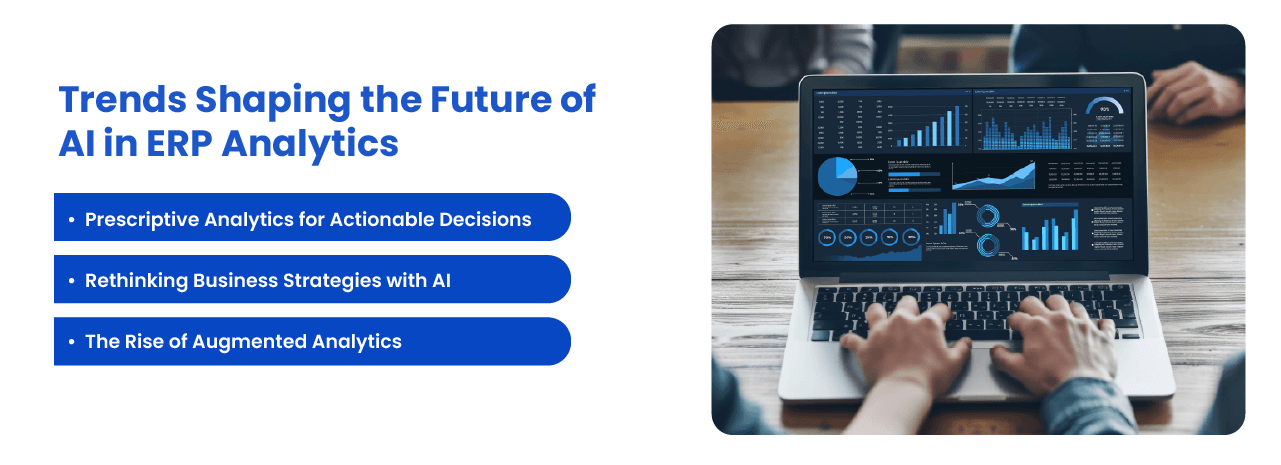
Augmented Analytics
Augmented analytics helps automate data preparation, pattern detection, visualization, and explanation. Instead of presenting another dashboard for employees to interpret, an ERP system can highlight what changed, why it may have changed, and which records require attention.
Prescriptive Decision Support
Prescriptive analytics is moving ERP reporting closer to operational action. Rather than only forecasting a shortage, the system may compare suppliers, lead times, stock locations, and expected demand before suggesting a response.
For a supply chain example, see our guide to prescriptive analytics in supply chain management.
Controlled Use of AI Agents
AI agents can perform multi-step tasks such as preparing reports, reviewing inventory availability, routing approvals, or summarizing purchase requests. These workflows require clear permissions, audit trails, validation rules, and limits on what an agent can change without approval.
How to Measure the Value of AI-Driven ERP Analytics
The success of an AI analytics initiative should be measured through operational results rather than the number of models or dashboards created. Relevant performance measures may include:
- Forecast accuracy
- Inventory availability and stockout rates
- Time required to prepare reports
- Exception detection and resolution time
- Procurement and production planning accuracy
- Reduction in manual data processing
- User adoption of analytics recommendations
Organizations should establish a baseline before implementation and compare results after the system has been used under normal operating conditions.
Building AI Analytics Into an ERP System
AI-driven analytics can make ERP data more useful by supporting forecasting, exception detection, reporting, and operational decision-making. Its value depends on how well the technology is connected to real workflows and whether users can understand and act on the information it provides.
Businesses should begin with a defined operational problem, reliable data, and a measurable objective. Starting with a focused use case is generally more practical than attempting to introduce AI across every ERP module at once.
Organizations using custom or cloud ERP solutions should also consider system architecture, integration requirements, security, data ownership, and long-term model maintenance during planning.
How We Help With ERP Analytics
NOI Technologies helps businesses make ERP data more useful through reliable reporting, forecasting, and alerts for operational exceptions. That often starts with data engineering to prepare and connect the data, followed by AI implementation where a specific use case can be tested and measured.
If you need help deciding where to begin, our ERP consulting team can review the current systems, data quality, and workflows.
Evaluate AI Analytics Opportunities in Your ERP System
Discuss your reporting, forecasting, data integration, or workflow automation requirements with our ERP specialists.