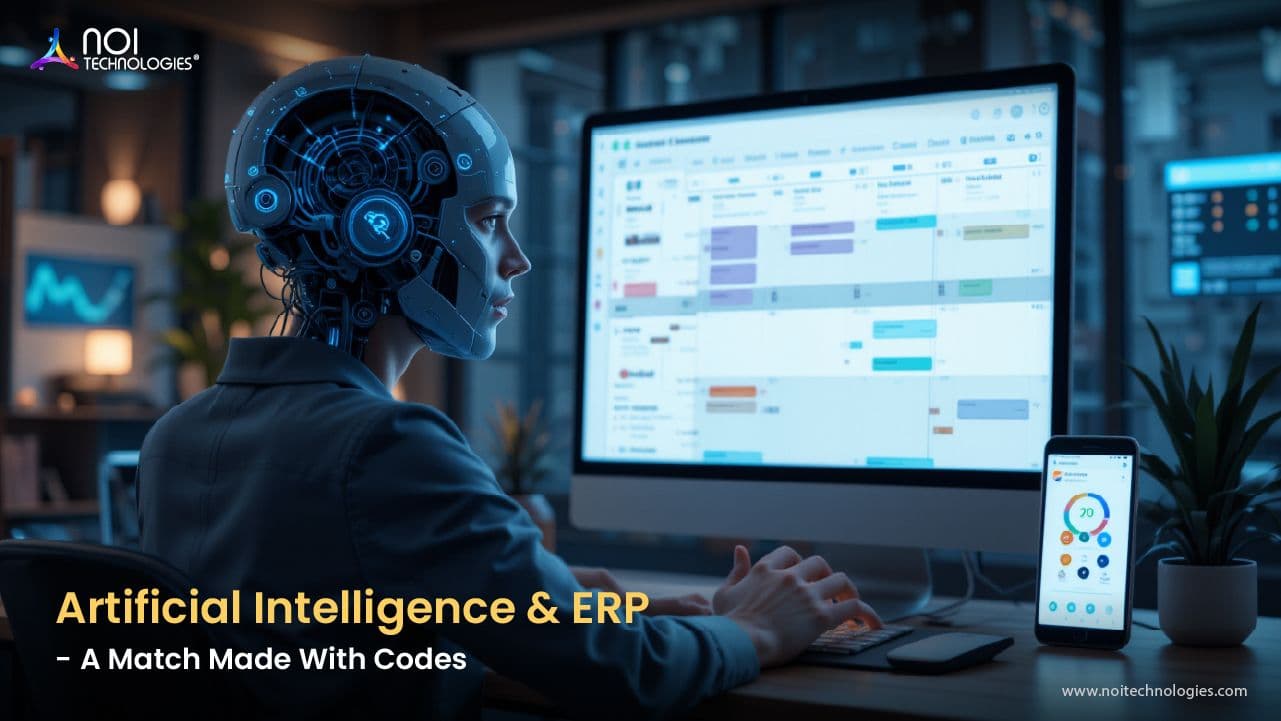
Implementing AI and ERP together can help businesses automate workflows, improve productivity, and make better use of data. When Artificial Intelligence and Enterprise Resource Planning systems work together, companies can streamline operations, reduce manual effort, and gain deeper business insights.
How AI and ERP Work Together to Make Businesses Smarter
Businesses can use AI tools and ERP software to automate repetitive tasks, optimize processes, and analyze business data more effectively. This combination helps companies improve decision-making, increase efficiency, and support long-term growth.
In an AI and ERP integration, the ERP provides business data such as orders, invoices, inventory, and transactions. An AI tool analyzes selected data or documents and returns a prediction, classification, or suggested action to a workflow. The team still needs to check the result and decide which actions can be automated and which require approval.
Minimizing Manual Work with AI-Driven ERP Efficiency
ERP software already helps automate many business tasks, but most systems still require human input for approvals, reporting, and data management. Integrating AI with ERP reduces manual work, lowers the risk of human error, and allows teams to focus on strategic tasks that require critical thinking and decision-making.
Advanced Data Insights Through AI-Integrated ERP Systems
ERP systems help businesses track performance, but AI takes data analysis further by identifying patterns, trends, and opportunities that teams may miss. AI-enabled ERP systems support faster and more accurate data analysis, helping businesses make informed decisions and improve operational performance.
Accelerated Automation with AI-Driven ERP Systems
AI can support tasks such as extracting invoice details, flagging unusual transactions, forecasting demand, or suggesting inventory actions. The ERP can then route the result through existing checks and approvals. Start with one task, measure the time spent and the number of corrections needed, and expand automation only when the results are reliable.
How to Prepare for AI and ERP Integration
To get the best results from AI and ERP integration, businesses need the right technology, team mindset, and implementation support. Here are a few important steps to consider.
Check ERP Data and Integration Readiness
Before adding AI, check whether the ERP holds reliable data and can share the information needed for a specific use case. Review available APIs, data permissions, update frequency, and how results will return to the ERP workflow. A cloud-based ERP may offer useful integration options, but cloud hosting is not a requirement for every AI and ERP project.
Build an Open-Minded Team
AI adoption requires a team that is ready to explore new technologies, workflows, and ways of solving problems. Employees, stakeholders, and ERP users should understand how AI can support their work instead of replacing their value. This mindset helps businesses adopt AI-powered ERP systems more effectively.
Work with an Experienced AI-ERP Implementation Team
AI and ERP integration can be complex, especially for businesses managing multiple departments, workflows, and data sources. With the right AI services, businesses can define clear goals, choose the right features, and deploy an ERP solution that supports long-term growth.
Why AI and ERP Together Are the Future
Digital transformation is no longer optional for growing businesses. By combining AI with ERP, companies can build smarter, more productive, and more efficient operations. AI-augmented ERP systems help businesses automate workflows, improve data analysis, reduce errors, and scale with confidence.
Unlock the Power of AI and ERP Integration
Want to automate smarter, analyze faster, and scale more efficiently? Let’s talk about how AI-powered ERP can support your next stage of growth.