Moqui is an open-source enterprise application framework used to build custom ERP systems, business applications, and workflow automation tools. It provides tools for managing data, business services, screens, security, and integrations.
Moqui Framework is the technical foundation. Mantle adds reusable business data models, services, and screens, while an implemented application combines these capabilities with the configuration and custom development required by the business.
What Is the Moqui Framework?
With the right configuration and development, Moqui can support business functions such as inventory management, supply chain management, accounting, HR, manufacturing, order management, and customer operations.
Moqui is built with Java and Apache Groovy and can work with tools such as Elasticsearch for search and data-related capabilities. This technology foundation supports performance, extensibility, and scalability for custom enterprise applications. Moqui’s modular architecture allows businesses to modify features, extend functionality, and build custom solutions around specific operational requirements.
Modern businesses often need their ERP systems to connect with third-party tools, legacy systems, and external applications. Moqui supports this through a flexible framework where business applications, services, and data can work together in a more connected environment. This helps improve data consistency, reduce manual work, and support better operational visibility.
Moqui at a Glance
| Type | Open-source enterprise application framework |
| Common Use Cases | Custom ERP systems, workflow automation, enterprise applications, integrations, and business process management |
| Core Technologies | Java, Apache Groovy, and related enterprise development tools |
| Best For | Businesses that need custom workflows, flexible integrations, and developer-controlled ERP applications |
| Not Ideal For | Businesses looking for a simple plug-and-play ERP with minimal development work |
Industries That Can Benefit from Moqui-Based ERP Applications
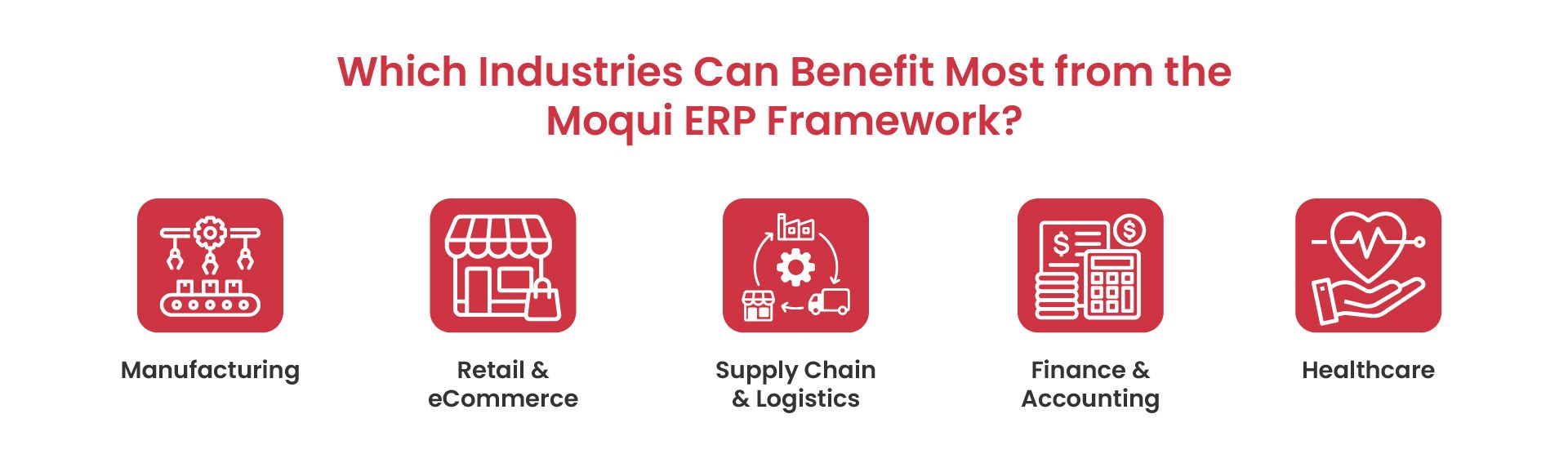
Moqui is an open-source enterprise application framework that can be used to build ERP systems and custom business applications for different industries, especially those with complex workflows, integrations, and data management needs.
- Manufacturing: Moqui can support manufacturing companies with production planning, inventory control, supply chain coordination, and custom workflow automation.
- Retail and E-commerce: Moqui can help businesses build systems for inventory management, order processing, customer data management, and point-of-sale or e-commerce integrations.
- Supply Chain and Logistics: Moqui can support supply chain and logistics operations by helping businesses manage inventory, shipments, procurement, warehouse workflows, and distribution processes.
- Finance and Accounting: Moqui-based systems can support financial workflows such as invoicing, transactions, billing, reporting, and tax-related processes when configured for specific business needs.
- Healthcare and Service Operations: Healthcare and service organizations can use Moqui-based systems for administrative workflows such as billing, inventory, scheduling, and internal process management when proper security and compliance controls are implemented.
Key Features of the Moqui Framework
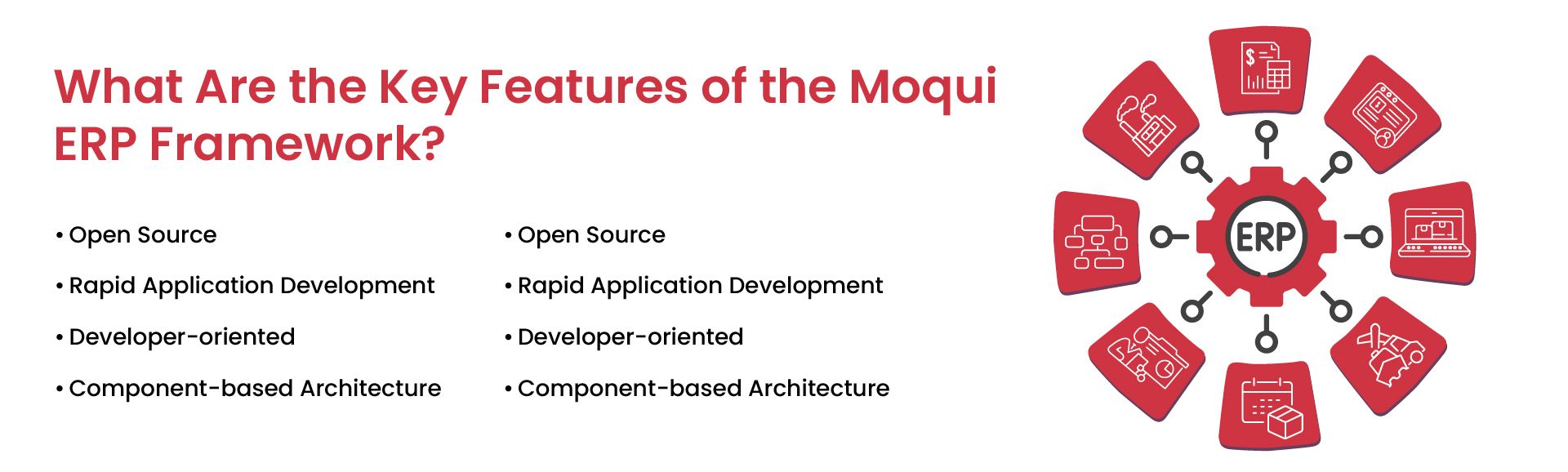
Moqui provides a range of framework-level features for building custom ERP systems, enterprise applications, workflow automation tools, and integrations. Here are some of its key capabilities:
- Open Source: Moqui is an open-source enterprise application framework, allowing businesses and developers to use, customize, and extend the framework without traditional proprietary software licensing fees.
- Rapid Application Development: Moqui includes tools for screens, services, entities, forms, and business logic, helping developers build enterprise applications faster with reusable framework components.
- Developer-Oriented: Built with Java and Groovy, Moqui gives developers a structured framework for creating, customizing, and extending enterprise applications.
- Component-Based Architecture: Moqui uses a component-based structure that allows teams to add, modify, or extend application components based on business requirements.
- Data Management: Moqui includes entity and data management tools that help developers model business data, manage database interactions, and support reporting or analytics requirements.
- Security Controls: Moqui includes security features such as user authentication, authorization, role-based access control, and permission management for enterprise applications.
- Integration Friendly: Moqui supports integrations with third-party applications, legacy systems, APIs, and external services, helping businesses connect different parts of their technology stack.
- Scalability and Performance: Moqui is designed to support scalable enterprise applications, including clustered deployments and performance-focused configurations for growing business needs.
When Moqui Is a Good Fit for ERP Applications
Moqui is most useful when an organization needs flexible workflows, integrations, developer control, and a framework that can support connected enterprise applications. Businesses with mostly standard requirements and limited development resources may be better served by a packaged ERP product.
- Open-source framework with no traditional proprietary licensing fees
- Highly configurable architecture for custom ERP and enterprise applications
- Open-source documentation and community resources
- Reusable framework tools that can speed up custom application development
- Supports cloud-ready and scalable deployment models
- Can be used to build centralized business applications and dashboards
- Supports integrations with APIs, external services, and custom code libraries
- Customizable user interfaces for business-specific workflows
- Built-in framework tools for entities, services, screens, security, workflow, and integrations
Moqui is not automatically the best choice for every business. Evaluate whether your requirements call for custom applications and developer control or more ready-made ERP functionality. Compare the available applications, required extensions, integrations, implementation effort, and ongoing support before selecting a platform. For side-by-side comparisons, see Moqui vs Apache OFBiz, Moqui vs Odoo, and Moqui vs SAP.
Real-World Examples of Moqui-Based ERP Applications
NOI Technologies has worked with clients across ecommerce, fulfillment, advertising workflows, and retail operations using applications built with the Moqui Framework. The examples below show how Moqui can support different business processes and enterprise workflows.
NOGIN: NOI developed connected WMS, OMS, and ecommerce capabilities using Moqui. Read the NOGIN Moqui case study for the project scope.
Fulfillment Plus NY: NOI developed a custom Moqui-based ERP and WMS for its 3PL operations. Read the Fulfillment Plus NY case study for the project scope.
Ads2Publish worked with NOI Technologies on a Moqui-based application for booking newspaper advertisements online. Read the Ads2Publish case study for the project scope.
- Ferns N’ Petals: Moqui-based systems can support order processing, supply chain workflows, customer engagement, and back-office operations.
Planning a Moqui Application?
If you are considering Moqui for your business, NOI Technologies can assess your workflows, integrations, and implementation requirements. See our Moqui development and consulting services.