Businesses generate data through customer transactions, websites, enterprise systems, mobile applications, social platforms, connected devices, and third-party services. However, collecting large amounts of data does not automatically make that information useful.
Data must be collected, cleaned, organized, secured, and delivered in a format that employees, reporting tools, and business applications can use. Data engineering provides the technical foundation required to manage this process reliably.
Without a well-designed data infrastructure, organizations may struggle with disconnected systems, inconsistent reports, duplicate records, delayed analysis, and limited visibility across departments. Professional data engineering services can help resolve these issues by creating dependable pipelines and centralized data platforms.
What Is Data Engineering?
Data engineering is the practice of designing, building, and maintaining systems that collect, process, store, and deliver data. Its purpose is to make information accurate, accessible, secure, and suitable for reporting, analytics, automation, and machine learning.
Data engineers work with structured information, such as customer and transaction records, as well as semi-structured and unstructured information from application logs, documents, connected devices, and digital platforms.
The work extends beyond transferring information from one system to another. It includes establishing how data is validated, transformed, stored, monitored, protected, and made available throughout the organization.
Core Components of Data Engineering
Data Ingestion
Data ingestion is the process of collecting information from different sources and transferring it to a central platform for processing or analysis.
These sources may include ERP and CRM applications, ecommerce platforms, mobile applications, websites, databases, IoT devices, marketing systems, and third-party APIs.
Depending on the business requirement, data may be collected in scheduled batches or processed continuously through real-time streaming pipelines. A reliable ingestion process should be scalable, monitored, and capable of handling changes in source systems without interrupting downstream reporting.
Data Cleaning and Transformation
Raw data often contains incomplete records, inconsistent formats, duplicate values, incorrect entries, and information that is not relevant to the intended analysis.
Data cleaning identifies and corrects these issues. Transformation then converts the information into consistent structures, formats, and definitions that can be used across departments and reporting systems.
For example, customer records from multiple applications may use different date formats, location names, product identifiers, or currency values. A transformation process can standardize these differences before the information reaches a dashboard or analytical model.
Data Lakes and Data Warehouses
Organizations need storage systems that match the type, volume, and intended use of their data.
A data warehouse generally stores structured and processed information for reporting and business intelligence. A data lake can store larger volumes of raw, semi-structured, and unstructured information for advanced analytics, machine learning, or future processing.
Some organizations use both approaches through a combined architecture. The appropriate design depends on factors such as data volume, processing speed, reporting needs, security requirements, and expected growth.
Dimensional structures may also be used to organize warehouse data for faster and more consistent reporting. Learn more in our guide to dimensional modeling in data warehouses.
Data Quality and Governance
Reports and analytical models are only reliable when the underlying information is accurate and consistent. Data engineering teams establish validation rules, monitoring processes, ownership standards, and documentation to protect data quality.
Data governance may also cover:
- Data definitions and naming standards
- Metadata management
- Data lineage and traceability
- Access permissions
- Retention requirements
- Compliance controls
- Quality monitoring and issue resolution
These controls help users understand where information came from, how it was changed, and whether it is suitable for a particular business purpose.
Business Intelligence and Analytics
Business intelligence tools such as Power BI, Tableau, and Looker depend on reliable data sources. A dashboard may look polished while still presenting inaccurate information if its pipelines, definitions, or source records are inconsistent.
Data engineering prepares and delivers the information required by reporting and analytics platforms. This includes managing refresh schedules, performance, access controls, transformations, and data dependencies.
Why Data Engineering Matters to Businesses
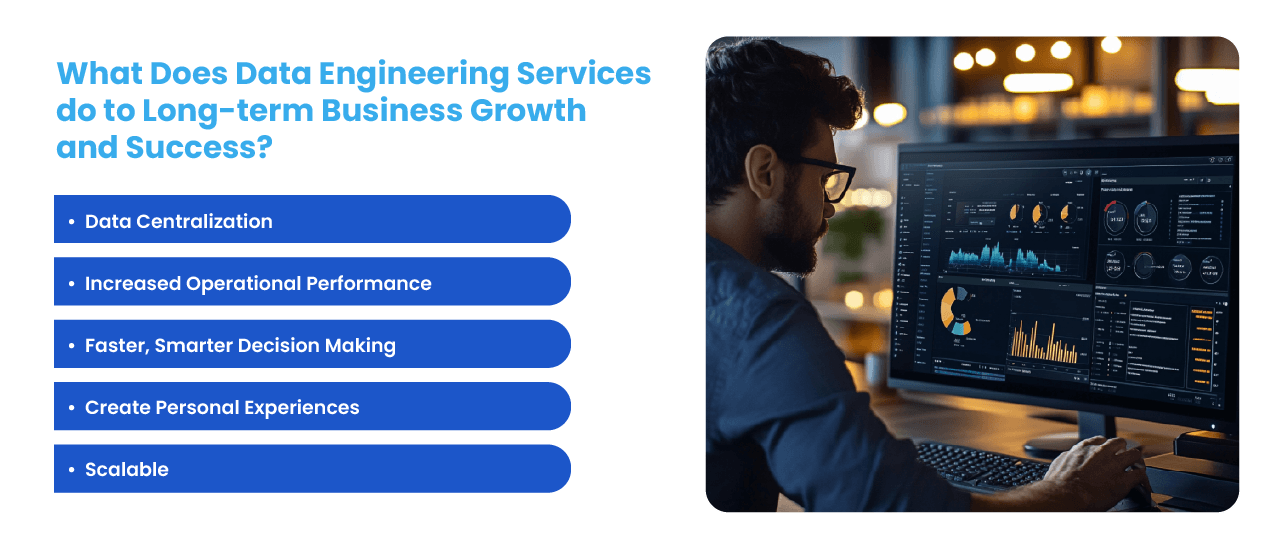
Even advanced analytical tools cannot produce dependable results without accessible, high-quality data. A strong data engineering foundation can improve several areas of business performance.
Centralized Business Data
Important information is often distributed across accounting software, CRM platforms, ecommerce systems, spreadsheets, warehouse applications, and marketing tools.
Data engineering connects these sources and makes the information available through a consistent platform. This reduces data silos and helps departments work from aligned definitions and records.
More Reliable Reporting
Manual reporting often requires employees to export files, combine spreadsheets, correct inconsistencies, and repeat the same work during every reporting period.
Automated pipelines can collect and prepare the required data on a defined schedule. This reduces manual effort and allows teams to spend more time interpreting results rather than preparing them.
Faster Decision-Making
Delayed or inconsistent information makes it difficult for managers to respond to changing customer behavior, inventory levels, operational problems, and market conditions.
Well-designed pipelines can provide more current information to dashboards and operational systems. This helps decision-makers identify changes earlier and act using consistent data.
Improved Customer Insights
Customer information may be divided among sales, support, ecommerce, marketing, and billing systems. Connecting these records can create a more complete view of customer activity.
Businesses can use this information to improve audience segmentation, service interactions, product recommendations, retention analysis, and campaign measurement. Personalization should still follow applicable privacy, consent, and data protection requirements.
Scalable Data Operations
Data volume and processing requirements usually increase as a business adds customers, products, locations, applications, or connected devices.
A scalable data architecture allows storage and processing capacity to expand without requiring the entire platform to be rebuilt. Cloud-based systems can provide flexible resources, although their usage and costs must still be monitored carefully.
Support for Automation and Machine Learning
Automation and machine learning systems require consistent and properly prepared information. Poor-quality inputs can lead to inaccurate predictions, failed workflows, or unreliable decisions.
Data engineering supplies the pipelines, feature data, monitoring, and storage layers required to support these systems in production environments.
Common Signs That a Business Needs Data Engineering
An organization may need to improve its data infrastructure when:
- Different departments report conflicting figures.
- Employees repeatedly combine information through spreadsheets.
- Reports take too long to prepare or refresh.
- Important data is trapped inside disconnected applications.
- Duplicate or incomplete records affect business decisions.
- Existing systems cannot handle increasing data volumes.
- Teams lack visibility into where data originated or how it changed.
- Analytics or machine learning projects are delayed by data-quality issues.
These problems are not always solved by purchasing another reporting tool. In many cases, the underlying pipelines, storage architecture, definitions, and governance processes must be addressed first.
How a Data Engineering Project Typically Works
A data engineering project should begin with a review of current systems and business requirements rather than immediately selecting tools.
1. Assess Existing Data Sources
The team identifies applications, databases, files, APIs, reporting systems, ownership responsibilities, and known quality problems.
2. Define Business Requirements
Stakeholders determine which reports, operational processes, analytics use cases, and performance goals the platform must support.
3. Design the Data Architecture
The technical team selects suitable ingestion methods, storage systems, processing frameworks, security controls, and integration patterns.
4. Build and Test Pipelines
Data pipelines are developed with validation, transformation, monitoring, error handling, and recovery processes.
5. Establish Governance and Monitoring
Organizations define ownership, quality rules, access controls, documentation, and procedures for responding to pipeline or data issues.
6. Improve the Platform Over Time
Data systems require ongoing maintenance as business requirements, source applications, schemas, and data volumes change.
How NOI Technologies Supports Data Engineering Projects
NOI Technologies helps businesses design and develop data platforms based on their operational requirements, existing systems, and analytical goals.
Our data engineering services can include:
- Data architecture assessment and planning
- Batch and real-time pipeline development
- Data integration and migration
- Data warehouse and data lake development
- Data cleaning and transformation
- Business intelligence integration
- Cloud data platform development
- Data quality and monitoring processes
- Ongoing platform maintenance and optimization
We work with ecommerce, finance, manufacturing, healthcare, SaaS, and other organizations that need to connect fragmented systems or improve how they manage and use business data.
Build a More Reliable Data Foundation
Data engineering turns disconnected and inconsistent information into a dependable resource for reporting, analytics, automation, and operational decision-making.
The most effective data platforms are not defined by the number of tools they use. They are designed around clear business requirements, reliable pipelines, consistent definitions, appropriate security controls, and measurable outcomes.
Discuss your data sources, reporting challenges, integration needs, and platform requirements with NOI Technologies.