ERP implementation is often one of the largest technology investments a growing or mid-sized business will make. Unclear pricing, restrictive contract terms, poorly defined responsibilities, and weak service agreements can quickly push a project over budget.
Effective ERP contract negotiation involves more than lowering software licensing fees. It requires identifying hidden costs, limiting vendor lock-in, protecting business data, assigning implementation responsibilities, and planning for long-term support.
This guide explains what an ERP contract should include, which mistakes to avoid, and how to protect the long-term value of your investment.
Understanding Total Cost of Ownership in ERP Contracts
Before negotiating an ERP agreement, calculate the complete total cost of ownership. The initial software price represents only part of the investment.
ERP costs may include:
- Software licensing or subscription fees
- Implementation and configuration
- Data migration and validation
- Third-party integrations
- Custom development
- User training and change management
- Support and maintenance
- Infrastructure or cloud hosting
- Software upgrades and renewals
Understanding these expenses helps your organization compare vendor proposals accurately and avoid selecting an ERP system based only on its upfront price. It also provides a clearer basis for comparing open-source and proprietary ERP systems.
ERP Contract Checklist: What Should Be Defined?
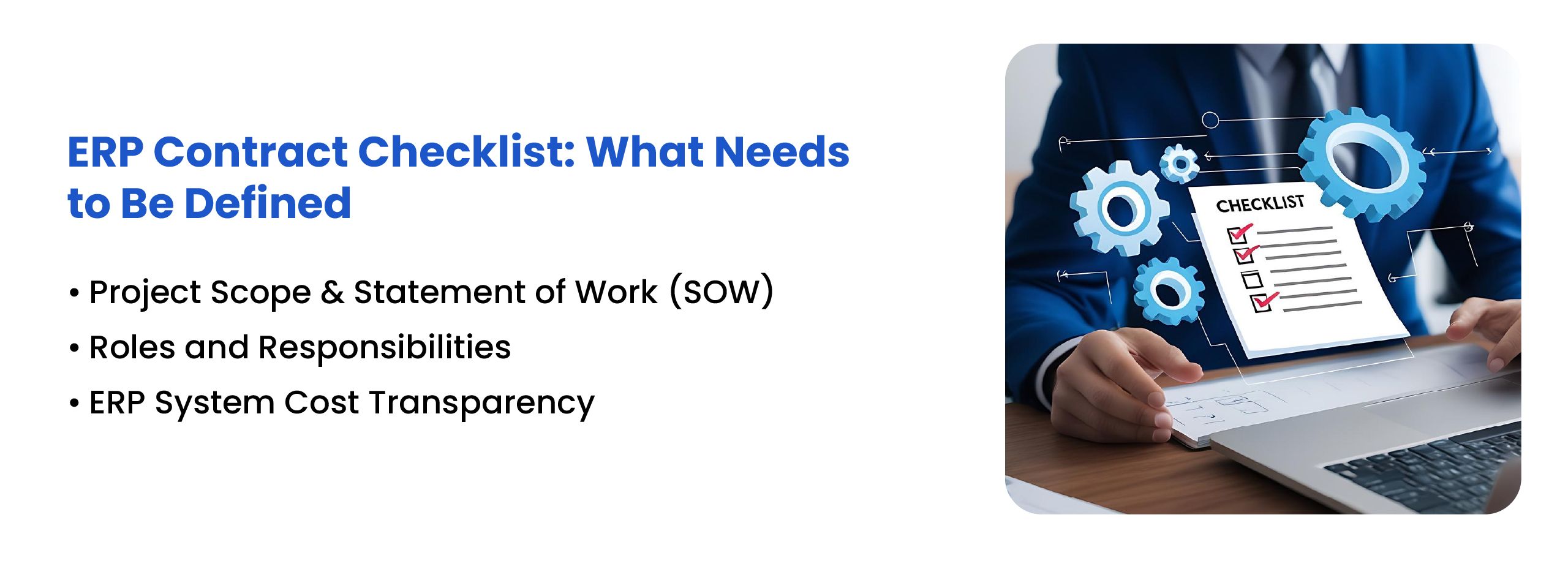
1. Project Scope and Statement of Work
The statement of work should document the functional and technical requirements included in the project. It should list deliverables, implementation phases, integrations, customizations, and legacy systems that will remain in use.
A clearly defined scope helps prevent disputes over whether a feature, integration, or configuration is included in the agreed price.
2. Roles and Responsibilities
Define which tasks will be handled by the ERP vendor, your internal team, and any third-party providers.
Responsibilities may include:
- Data preparation
- System configuration
- Integration development
- Testing
- User training
- Security reviews
- Project approvals
Assigning ownership to each activity reduces delays and prevents responsibility from being shifted between teams when problems arise.
3. Pricing and Cost Transparency
Request a detailed breakdown of licensing, implementation, support, maintenance, customization, integration, infrastructure, and third-party expenses.
The contract should also explain how additional work will be approved and billed. This is particularly important for change requests that fall outside the original project scope.
4. Implementation Timeline and Milestones
Document project phases, delivery dates, testing periods, approval deadlines, and go-live requirements. Each milestone should have measurable acceptance criteria.
The agreement should also explain how delays will be handled when they are caused by the vendor, the client, or an external provider.
5. Acceptance Testing
Define how the ERP system will be tested before deployment. The contract should specify testing responsibilities, defect categories, resolution timelines, and the conditions required for formal acceptance.
Without clear criteria, a vendor may consider implementation complete even when important workflows remain unfinished.
6. Data Ownership and Portability
The contract should confirm that your organization retains ownership of its business data.
It should also define:
- Available export formats
- Data retrieval timelines
- Migration assistance
- Export fees
- Data deletion after termination
These terms reduce vendor dependency and make future migration more manageable.
7. Service Level Agreements
Service level agreements should define:
- System availability
- Support hours
- Response times
- Resolution targets
- Escalation procedures
- Maintenance windows
- Remedies for repeated failures
Terms such as reasonable support or timely resolution are too vague to enforce. Service expectations should be measurable.
8. Security and Privacy Requirements
The ERP contract should address access controls, encryption, backups, retention policies, audit rights, breach notification, and applicable compliance requirements.
For cloud-based systems, confirm where the data will be hosted and which parties may access or process it.
9. Post-Implementation Support
Define the support period that begins after go-live, including warranty coverage, system monitoring, issue resolution, updates, maintenance, and knowledge transfer.
Review which services are included and which will result in additional fees.
10. Termination and Exit Terms
The agreement should explain how the contract may be terminated and which fees may apply.
It should also define how your data, configurations, documentation, integrations, and custom development will be provided when the relationship ends.
Common ERP Contract Negotiation Mistakes
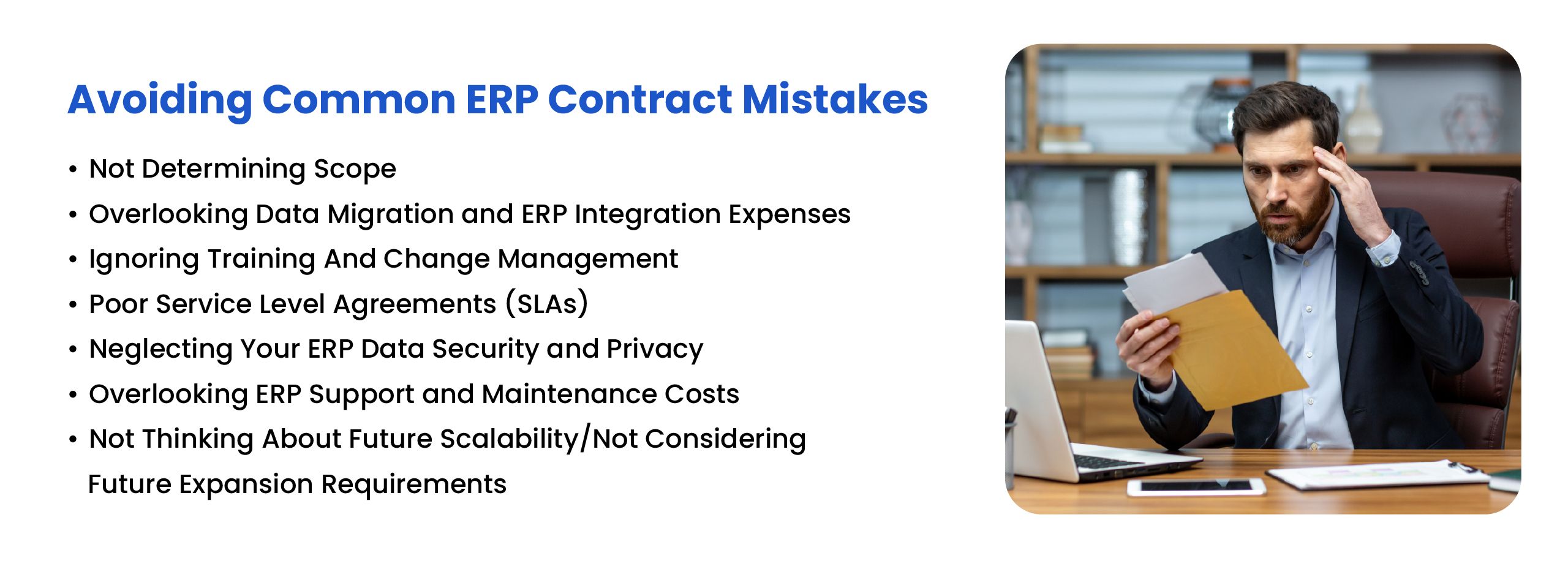
Leaving the Project Scope Unclear
An unclear project scope creates opportunities for scope creep, additional charges, and implementation delays.
Document detailed requirements before signing the agreement and establish a formal process for approving changes.
Overlooking Data Migration Costs
Legacy data is rarely ready for immediate migration. It may contain duplicate records, missing values, inconsistent formats, or outdated information.
The contract should define who will extract, clean, map, validate, import, and test the data.
Ignoring Integration Responsibilities
ERP systems often need to connect with ecommerce platforms, accounting applications, CRM software, payment services, warehouse systems, and other tools.
The contract should identify who will build, test, document, maintain, and troubleshoot each integration.
For API-based ERP integrations, confirm whether API limits, connector fees, middleware expenses, or third-party subscriptions apply.
Underestimating Training and Change Management
ERP implementation changes how employees complete daily tasks. Without adequate training, users may rely on old processes, create workarounds, or use the system incorrectly.
Include the number of training sessions, supported user groups, training formats, documentation requirements, and post-launch assistance in the agreement.
Accepting Weak Service Commitments
A vendor may promise reliable support without defining response times, escalation procedures, or resolution targets.
Without measurable service commitments, it becomes difficult to hold the provider accountable.
Overlooking Renewal and Maintenance Costs
ERP systems require updates, monitoring, troubleshooting, and technical support after deployment.
Review terms for renewals, annual price increases, software updates, security patches, bug fixes, and post-implementation ERP maintenance.
Failing to Plan for Growth
The contract should support additional users, locations, business units, integrations, and transaction volumes.
Review how pricing changes as the organization grows and whether access to APIs, reporting tools, automation, or newer features requires a higher subscription tier.
ERP Vendor Negotiation Tips
Compare Proposals Using the Same Requirements
Provide each vendor with the same requirement list, integration scope, user counts, transaction volumes, and support expectations.
This makes proposals easier to compare and reduces the risk that one vendor appears cheaper simply because important services were excluded.
Separate Essential and Optional Requirements
Identify which features are required for launch and which can be implemented later.
This helps control the initial scope and prevents lower-priority customizations from delaying critical workflows.
Require Assumptions to Be Written Down
Vendor proposals often depend on assumptions about data quality, internal staffing, system access, or integration readiness.
Ensure these assumptions are documented so they cannot later be used to justify unexpected charges.
Negotiate Change Request Procedures
The contract should define how changes will be estimated, approved, scheduled, and billed.
No additional work should begin without written approval from the appropriate project owner.
Limit Renewal Price Increases
Where possible, negotiate a cap on annual increases for subscriptions, support, hosting, or maintenance.
This makes long-term costs more predictable and reduces the risk of significant price changes after the system becomes difficult to replace.
Establish an Escalation Process
The contract should provide a structured process for unresolved implementation, support, billing, and performance issues.
Include responsible contacts, escalation timeframes, executive review procedures, and dispute resolution methods.
Have Legal and Technical Teams Review the Agreement
Legal teams can review liability, termination, privacy, warranties, and dispute terms. Technical teams can assess architecture, integrations, security, data portability, and implementation assumptions.
Both perspectives are necessary because ERP contracts combine legal, commercial, and technical obligations.
Protect Your ERP Investment
NOI Technologies also builds ERP systems. We recommend putting scope, assumptions, acceptance criteria, support commitments, and data access terms in writing because both the client and the delivery team need a clear agreement.
ERP contract negotiation is not simply a purchasing exercise. It is an opportunity to control implementation risks, establish vendor accountability, protect business data, and prepare the system for future growth.
NOI Technologies brings more than 10 years of ERP experience to system planning, customization, integration, implementation, and ongoing support.
Our team helps organizations define realistic requirements before an agreement is signed, so the scope, responsibilities, and support terms reflect the project they actually need.
Plan Your ERP Project with Greater Confidence
Work with NOI Technologies to define ERP scope, integrations, implementation requirements, and long-term support responsibilities.
Frequently Asked Questions
Why is total cost of ownership important in ERP contract negotiation?
Total cost of ownership includes licensing, implementation, data migration, integrations, customization, training, support, infrastructure, and future upgrades. Reviewing these expenses helps businesses create a realistic budget and compare vendor proposals based on long-term value rather than upfront price alone.
What are the most common ERP contract mistakes?
Common mistakes include leaving the project scope unclear, overlooking data migration costs, accepting weak service level agreements, failing to plan user training, and ignoring future scalability.
How can businesses prevent ERP vendor lock-in?
Define data ownership, portability, export formats, API access, termination assistance, and migration responsibilities in the contract. Your organization should be able to retrieve its data and documentation without unreasonable restrictions or fees.
What should an ERP service level agreement include?
An ERP service level agreement should define system availability, support hours, response times, resolution targets, escalation procedures, maintenance windows, and remedies for repeated service failures.
Who should review an ERP contract?
An ERP contract should be reviewed by legal, technical, financial, operational, and procurement stakeholders. Each team can identify different risks related to pricing, implementation, data, security, integrations, and business continuity.