Legacy ERP systems can limit business growth when they become difficult to maintain, expensive to customize, and hard to integrate with modern tools. Many companies migrate from legacy ERP software to open-source ERP systems to reduce costs, improve flexibility, and gain better control over business processes.
Open-source ERP migration is part of ERP modernization. It helps businesses improve automation, reporting, integrations, scalability, and operational efficiency.
Why Businesses Migrate from Legacy ERP to Open-Source ERP
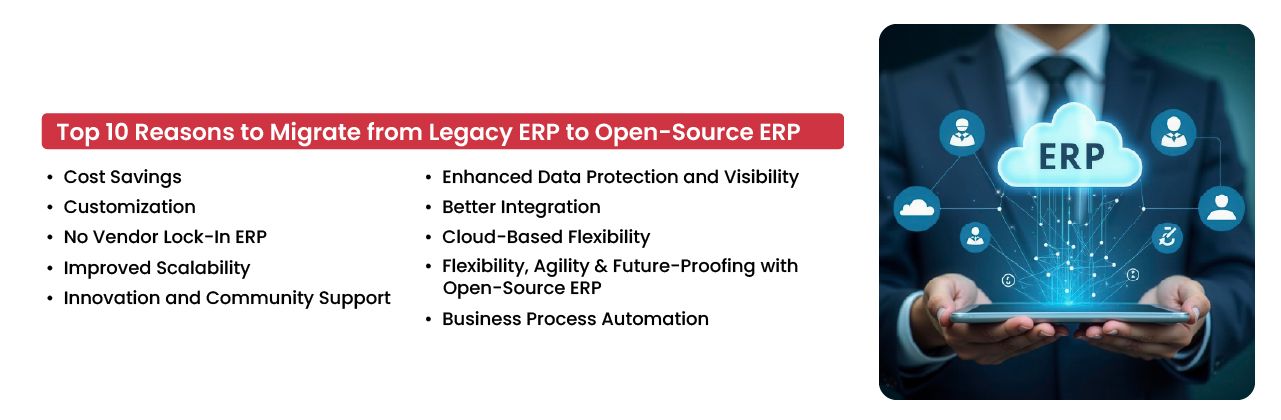
1. Lower ERP Ownership Costs
Legacy ERP systems often include licensing fees, maintenance charges, hardware costs, and vendor support expenses. Open-source ERP systems can reduce total cost of ownership by giving businesses more control over implementation, hosting, customization, and support.
2. Better Customization
Traditional ERP platforms can be difficult to customize because they often use rigid structures. Open-source ERP software allows businesses to modify workflows, modules, reports, and integrations based on operational requirements.
3. Reduced Vendor Lock-In
Proprietary ERP systems can make businesses dependent on one vendor for updates, support, customization, and pricing. Open-source ERP gives companies more flexibility to choose developers, support teams, hosting options, and integration partners.
For more detail, read this comparison of open-source ERP vs proprietary ERP.
4. Improved Scalability
An ERP system should support business growth. Older ERP platforms may struggle when companies add users, locations, departments, products, or sales channels. Open-source ERP systems can be scaled across business units and workflows without requiring a complete system rebuild.
5. Faster Development and Updates
Open-source ERP platforms support faster development because businesses are not limited to a single vendor roadmap. New modules, integrations, reports, and process improvements can be added based on business needs.
6. Better Security Visibility
Unsupported legacy ERP systems can create security risks when updates and patches are no longer available. Open-source ERP gives technical teams more visibility into the codebase, making it easier to review, patch, and improve system security.
7. Easier ERP Integration
Modern businesses depend on connected systems such as CRM, ecommerce platforms, accounting software, warehouse management systems, analytics tools, and third-party APIs. Open-source ERP platforms are often easier to integrate because they support flexible architecture and API-based connectivity.
NOI Technologies provides ERP consultancy services for ERP planning, implementation, integration, and modernization.
8. Cloud ERP Flexibility
Many legacy ERP systems were built for on-premise environments. This can increase infrastructure costs and limit remote access. Cloud-based ERP solutions improve accessibility, reduce IT overhead, and support teams working across multiple locations.
Learn more about cloud ERP vs on-premise ERP.
9. Future-Ready ERP Architecture
Business requirements change over time. Companies need ERP systems that can support new workflows, automation, reporting, compliance, and customer requirements. Open-source ERP systems provide flexibility for long-term digital transformation.
10. Business Process Automation
Modern ERP systems help automate tasks across finance, inventory, procurement, order management, HR, reporting, and operations. ERP automation reduces manual errors, improves process speed, and gives teams better operational control.
This guide on ERP automation software explains how automation supports business process improvement.
11. AI-Ready ERP Systems
AI can improve ERP systems through forecasting, intelligent reporting, workflow automation, document processing, inventory planning, and operational analytics. Many legacy ERP systems are not designed to integrate easily with AI tools.
Open-source ERP platforms provide more flexibility for AI integration because ERP data, workflows, and modules can be connected with analytics tools, machine learning models, and automation systems.
Explore NOI Technologies' AI Services to learn how AI can support ERP automation, analytics, and business decision-making.
Benefits of Open-Source ERP Over Legacy ERP
- Lower total cost of ownership
- Greater customization control
- Reduced vendor dependency
- Better integration with modern tools
- Improved scalability
- Cloud deployment flexibility
- Faster implementation and upgrades
- Better support for business process automation
- Improved reporting and operational visibility
When Should a Business Consider Legacy ERP Migration?
Consider replacing a legacy ERP when unsupported software, recurring failures, reporting gaps, or integration limitations prevent essential work. Document the impact through specific examples, such as repeated manual reconciliation, delayed orders, or changes that the current system cannot support.
Before committing to migration, compare replacement with upgrading, extending, or improving the existing ERP. Open-source software may offer useful control over code and development, but the decision should account for functional fit, migration risk, implementation effort, and long-term maintenance responsibilities.
How to Plan a Successful ERP Migration
A successful ERP migration requires process review, data cleanup, integration planning, user role mapping, workflow testing, and phased implementation. These steps help reduce disruption during the transition.
NOI Technologies supports ERP planning, open-source ERP development, system integration, migration, and long-term support.
Open-Source Foundations for Custom ERP
Moqui provides an application framework for building business workflows, while Apache OFBiz includes business applications that teams can configure and extend. Both are worth evaluating when a business needs specialized workflows or integrations and has the resources to maintain a custom system.
Conclusion
Migrating from legacy ERP to open-source ERP can help businesses reduce costs, improve flexibility, avoid vendor lock-in, and build a more scalable digital foundation.
For companies dealing with outdated systems, limited integrations, and manual processes, open-source ERP migration can support long-term operational efficiency and ERP modernization.
Schedule a call to discuss your ERP migration or modernization plan.