
Small e-commerce businesses in the US need ERP software that connects inventory, orders, accounting, customer data, warehouse operations, and reporting in one place. The right ERP features help growing online retailers reduce manual work, avoid stock errors, improve fulfillment, and make better business decisions.
Running an e-commerce business is no longer only about listing products online and shipping orders. Small businesses now manage multiple sales channels, customer expectations, returns, taxes, supplier updates, inventory movement, and fulfillment workflows. When these tasks are handled through separate tools or spreadsheets, mistakes become common and growth becomes harder to manage.
A flexible ERP system helps solve this problem by bringing core business operations into a single connected platform. For small and growing e-commerce companies, this means better control over inventory, faster order processing, accurate financial data, and clearer visibility across the business.
Why ERP Matters for Small E-commerce Businesses
Small e-commerce teams often deal with limited staff, tight margins, and increasing order volume. Without a centralized system, teams may spend too much time updating inventory manually, checking order status across different platforms, fixing accounting errors, or answering customers without real-time information.
An ERP system reduces these problems by connecting sales, inventory, finance, warehouse, and customer management. Instead of using disconnected software for every department, businesses can manage daily operations from one system.
For example, when an order is placed on Shopify, Amazon, WooCommerce, or another sales channel, the ERP can update inventory, create fulfillment tasks, sync customer details, generate invoices, and support reporting without repeated manual data entry.
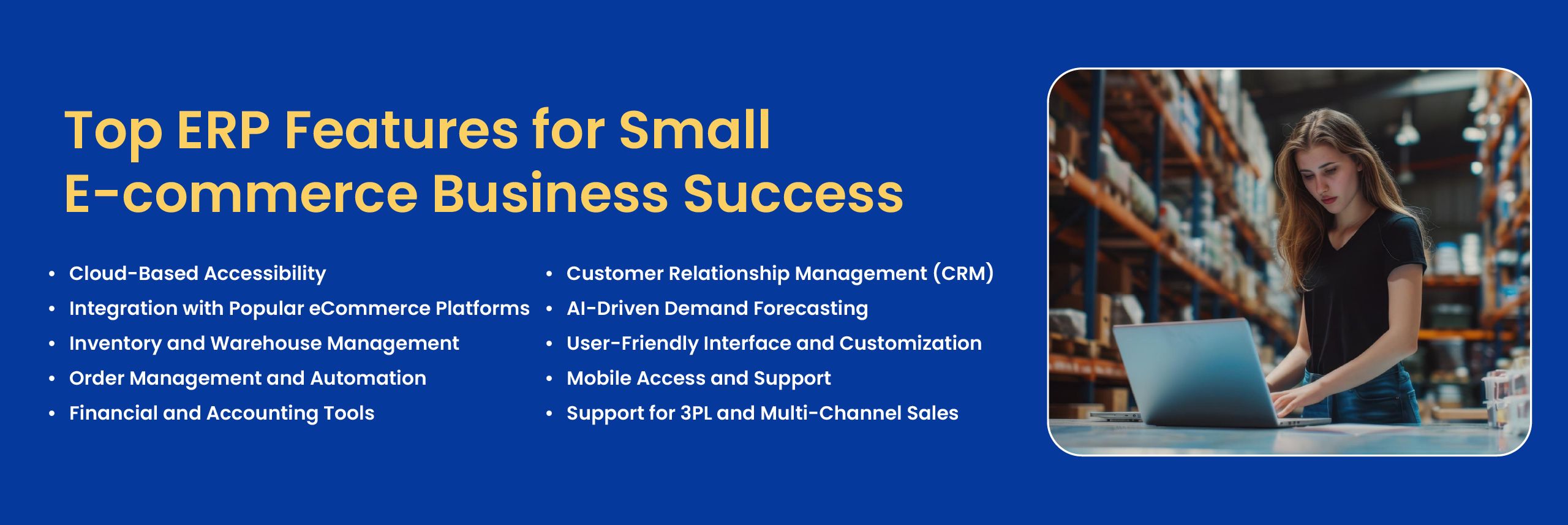
Top ERP Features for Small E-commerce Businesses
1. Cloud-Based Access
A cloud-based ERP system allows business owners and teams to access important data from anywhere with a secure internet connection. This is useful for small e-commerce businesses that work with remote teams, multiple warehouses, external accountants, or third-party fulfillment partners.
Cloud ERP also reduces the need for expensive on-premise servers and heavy IT maintenance. Businesses can manage orders, inventory, invoices, reports, and customer records without depending on local systems.
For companies planning to modernize their operations, a cloud-based ERP system can provide the flexibility needed to scale without rebuilding the entire technology stack later.
2. E-commerce Platform Integration
ERP software for e-commerce should integrate with popular online selling platforms such as Shopify, WooCommerce, Amazon, BigCommerce, Magento, and other marketplaces. These integrations help businesses sync orders, inventory, customer details, product information, and fulfillment updates automatically.
Without integration, teams often need to copy data between systems. This increases the risk of overselling, delayed shipments, wrong invoices, and inaccurate reporting.
A well-integrated ERP system keeps all sales channels connected, so the business can manage multi-channel growth from one centralized platform.
3. Inventory Management
Inventory management is one of the most important ERP features for small e-commerce businesses. The system should show real-time stock levels, reserved inventory, available inventory, reorder points, and product movement across locations.
Strong inventory management helps businesses avoid stockouts, reduce dead stock, and prevent overselling. It also helps teams understand which products are selling quickly and which items are tying up cash.
For e-commerce businesses with warehouse or fulfillment needs, inventory visibility becomes even more important. Businesses can also explore dedicated warehouse management system capabilities when they need more control over storage, picking, packing, and shipping workflows.
4. Warehouse and Fulfillment Management
As order volume grows, basic inventory tracking is not enough. Small e-commerce businesses need warehouse and fulfillment features that support receiving, putaway, picking, packing, shipping, returns, and shipment tracking.
ERP systems with warehouse management features can help teams reduce picking mistakes, improve order accuracy, and speed up fulfillment. Features such as barcode scanning, bin location tracking, batch tracking, and automated picklists can make daily warehouse operations more structured.
If a business works with fulfillment centers or logistics providers, stronger inventory and fulfillment visibility can help reduce delays and communication gaps. For more advanced fulfillment operations, tools like cloud 3PL inventory management software may also support multi-client and warehouse-specific needs.
5. Order Management and Automation
Order management is another core ERP feature. A good ERP system should capture orders from multiple channels, verify inventory availability, assign fulfillment tasks, update order status, and support invoicing.
Automation helps reduce repetitive work. For example, the ERP can automatically generate picklists, update stock after fulfillment, send shipping confirmations, and match payments with orders.
This gives small teams more time to focus on growth, customer service, and supplier management instead of manually updating order records all day.
6. Financial and Accounting Tools
Small e-commerce businesses need accurate financial data to manage cash flow, taxes, expenses, refunds, and profitability. ERP software should include or integrate with accounting features such as invoicing, accounts payable, accounts receivable, payment reconciliation, tax tracking, and financial reporting.
US sellers should also check whether the ERP can track sales by state and connect to a sales tax calculation service. Following the 2018 South Dakota v. Wayfair decision, states may require certain sellers to collect sales tax even without a physical presence there. Registration and collection requirements vary by state, so the software should support the rules that apply to the business.
When accounting is connected with orders and inventory, businesses can understand true product costs, sales performance, refund impact, and profit margins more clearly.
ERP-based financial management also reduces duplicate data entry between sales platforms, accounting software, and inventory tools.
7. Customer Relationship Management
Customer data should not live in disconnected tools. ERP systems with CRM features help businesses manage customer profiles, purchase history, communication records, returns, complaints, and service requests.
This helps small e-commerce businesses provide better support and more personalized service. Teams can quickly see what a customer ordered, whether the order was shipped, whether a return is active, and how often the customer buys.
Integrated CRM also supports targeted marketing, loyalty campaigns, and customer retention. Businesses can learn more about the value of connecting these systems through ERP and CRM integration.
8. Reporting and Analytics
ERP reporting helps business owners see what is actually happening across sales, inventory, finance, and fulfillment. Instead of guessing, teams can review dashboards and reports that show order volume, top-selling products, slow-moving stock, revenue, returns, and warehouse performance.
Useful ERP reports for e-commerce businesses include:
- Sales by channel
- Inventory availability
- Low-stock products
- Order fulfillment status
- Return rates
- Revenue and profit trends
- Customer purchase behavior
Better reporting helps small businesses make faster decisions and identify problems before they become expensive.
9. Demand Forecasting
Demand forecasting helps e-commerce businesses plan inventory based on past sales, seasonal trends, promotions, and customer demand patterns. This is especially useful for businesses that deal with fast-moving products, seasonal demand, or supplier lead times.
Modern ERP systems can use analytics and automation to suggest reorder quantities, highlight demand changes, and reduce the risk of overstocking or running out of inventory.
For small businesses, better forecasting means better cash flow. Instead of buying too much inventory or reacting too late, teams can plan purchasing with more confidence.
10. Mobile Access
Mobile ERP access allows business owners, warehouse staff, and sales teams to check important information from phones or tablets. This can be useful for inventory checks, order updates, warehouse tasks, approvals, and customer service.
For warehouse teams, mobile access can support barcode scanning, picking, stock transfers, and receiving. For owners and managers, it helps them monitor business activity without being tied to a desk.
Mobile access is especially helpful for small teams that need quick decisions and flexible operations.
11. Support for Multi-Channel Sales
Many e-commerce businesses sell through more than one channel. A small business may sell through its own website, Amazon, Walmart Marketplace, eBay, social commerce, and wholesale channels.
ERP software should support this multi-channel structure by centralizing orders, inventory, pricing, customer data, and reporting. This prevents each channel from becoming a separate data silo.
With multi-channel ERP support, businesses can reduce overselling, improve fulfillment accuracy, and understand which channels are actually profitable.
12. Customization and Scalability
Every e-commerce business has different workflows. Some businesses need advanced inventory rules. Others need custom invoicing, supplier workflows, returns handling, or fulfillment logic.
A customizable ERP system allows businesses to adapt the software to their processes instead of forcing the team to work around rigid software limitations.
Companies that need workflows beyond a standard ERP setup can explore our custom ERP development services.
Open-Source ERP Options for Small Ecommerce Businesses
For a small online store with standard workflows, a ready-to-use ERP such as Odoo or ERPNext is often the practical starting point. If the business develops specialized fulfillment rules, multiple warehouse workflows, or unusual integrations, frameworks such as Moqui and Apache OFBiz may be worth evaluating. Our guide to open-source ERP for ecommerce explores these options in more detail.
How to Choose the Right ERP Features
Small e-commerce businesses should not choose ERP software only because it has a long feature list. The better approach is to identify the biggest operational problems first.
Before choosing an ERP system, businesses should ask:
- Which sales channels need to be connected?
- Where do inventory errors happen most often?
- How are orders currently processed?
- Does the business need warehouse management features?
- Which accounting and tax workflows need automation?
- What reports does the owner or management team need?
- Will the system support future growth?
The right ERP should solve current problems while also supporting future growth. A small business may not need every advanced ERP module on day one, but it should choose a system that can scale as operations become more complex.
FAQs About ERP Features for Small E-commerce Businesses
What is the most important ERP feature for a small e-commerce business?
Inventory and order management are usually the most important ERP features for small e-commerce businesses. These features help prevent overselling, reduce fulfillment mistakes, and keep stock data accurate across sales channels.
Do small e-commerce businesses really need ERP software?
Small e-commerce businesses may need ERP software when spreadsheets and disconnected tools start causing order delays, inventory errors, accounting issues, or poor reporting. ERP becomes more valuable as order volume, product count, and sales channels increase.
Can ERP software connect with Shopify, Amazon, and WooCommerce?
Yes. Many ERP systems can integrate with platforms such as Shopify, Amazon, WooCommerce, BigCommerce, and Magento. These integrations help sync orders, inventory, customer data, and fulfillment updates automatically.
Is cloud ERP better for small businesses?
Cloud ERP is often a strong option for small businesses because it reduces the need for on-premise infrastructure, supports remote access, and makes scaling easier. It can also lower IT maintenance compared to traditional systems.
What is the difference between ERP and accounting software?
Accounting software mainly manages financial tasks such as invoices, payments, expenses, and reports. ERP software connects finance with other business areas such as inventory, orders, customers, warehouse operations, purchasing, and reporting.
Can ERP help with warehouse and fulfillment operations?
Yes. ERP systems with warehouse management features can support receiving, picking, packing, shipping, stock transfers, barcode scanning, and returns. This helps e-commerce businesses improve fulfillment speed and accuracy.
Final Thoughts
The right ERP features can help small e-commerce businesses in the US manage growth without losing control of daily operations. Cloud access, e-commerce integrations, inventory management, order automation, accounting, CRM, reporting, forecasting, mobile access, and customization all play an important role.
For growing businesses, ERP is not just back-office software. It becomes the central system that connects sales, inventory, fulfillment, finance, and customer service.
NOI Technologies helps businesses build flexible ERP solutions using custom development, open-source ERP frameworks, and scalable system architecture. Whether a business needs e-commerce ERP, warehouse workflows, CRM integration, or financial automation, the right ERP setup can reduce manual work and support long-term growth.
If your business needs a tailored ERP solution, schedule a call with NOI Technologies to discuss your requirements.